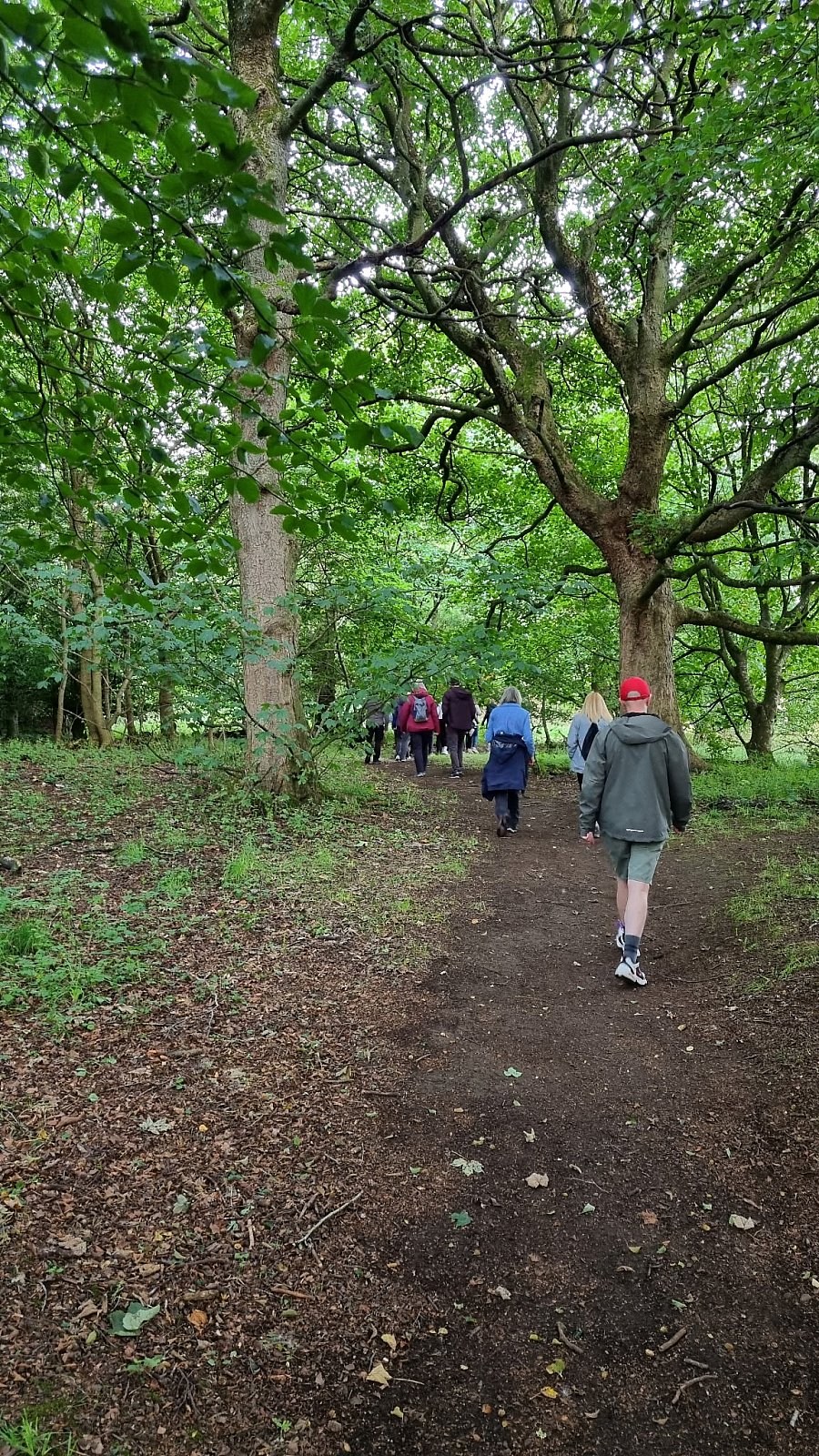
Nineteen Ramblers gathered outside the Livingston Inn on a beautiful sunny evening for our Meeting of Waters walk and what a lovely evening it turned out to be.
We were delighted to welcome Ian, Helen and Richard, who were joining us for their very first walk with the group. Before setting off, we paused to discover a little about our starting point, the Livingston Inn, which is the oldest building in Livingston Village.
Today it may look like a peaceful old inn, but in its coaching days it was a rather busier place. Travellers could stop to rest and take refreshments, change horses and, if their journey demanded it, stay the night. We discovered that by the 1780s the famous Edinburgh to Glasgow Flyer stagecoach could make the 50-mile journey in just over 24 hours, remarkably fast by the standards of the day!
There was also a literary connection to enjoy. Robert Burns is said to have stayed at the inn and penned The Bonnie Lass of Livingston during his visit. Not a bad pedigree for the building we were standing outside!
With the conversation flowing as freely as the evening sunshine, we set off towards the River Almond, following the river to the Almond Valley Heritage Centre and the site of the former Livingston Mill.
From grain to butter – and a community determined to save its history
It is easy to take the Almond Valley Heritage Centre for granted as a much-loved destination for families and visitors, but we discovered that this important part of Livingston’s history came remarkably close to disappearing altogether.
The buildings we can see today date from around 1770, although there had been a mill on this site for six or seven hundred years. Local farmers would bring their oats, peas and grain to be processed, with the grain first dried in a kiln before being ground between millstones powered by a huge 16-foot waterwheel, fed by the River Almond.
And the mill wasn’t just about flour. A later addition of a water-powered butter churn could produce an impressive 25kg of butter at a time, with butter being delivered as far afield as Pumpherston. We could almost picture the activity that must once have taken place here.
But by the 1960s, as the New Town was being built, the mill had fallen into a derelict state and was destined for demolition.
Fortunately, some of Livingston’s early new residents had other ideas.
Interested in the history they had discovered on their doorstep, they set about finding out whether the old mill could be rescued and perhaps become a focal point for an Almond Valley walk. Their efforts led to the formation of a mill restoration group in 1970. With help from the mill owner at the time, Lord Rosebery, who provided timber from his estate to help restore the great wooden wheel, the project gathered momentum.
Students from West Lothian College in Bathgate and Moray House College in Edinburgh, together with pupils from local schools and members of the restoration group, all played their part. Five years later, the mill had been brought back to life.
The buildings were subsequently recognised for their special architectural and historical interest, and when the Livingston Development Corporation purchased the site, this precious link with Livingston’s agricultural past was secured.
It was particularly uplifting to hear how a community came together to save something they believed was worth preserving. Their determination — and refusal to simply let their history disappear — means that generations of families have been able to enjoy this wonderful place ever since.
A landscape with a past
We continued along the River Almond to Almond Pools, where the tranquil water and surrounding vegetation provide a haven for plenty of wildlife.
It certainly looks peaceful today, but once again there was more to the landscape than first meets the eye. During the Second World War this was an opencast shale mine, and the River Almond had actually been diverted. The landscape we see today only emerged after the quarry closed in the 1950s, when the area was restored and the river found its new course.
It was a good reminder that even the most natural-looking parts of Livingston can have a surprisingly industrial past.
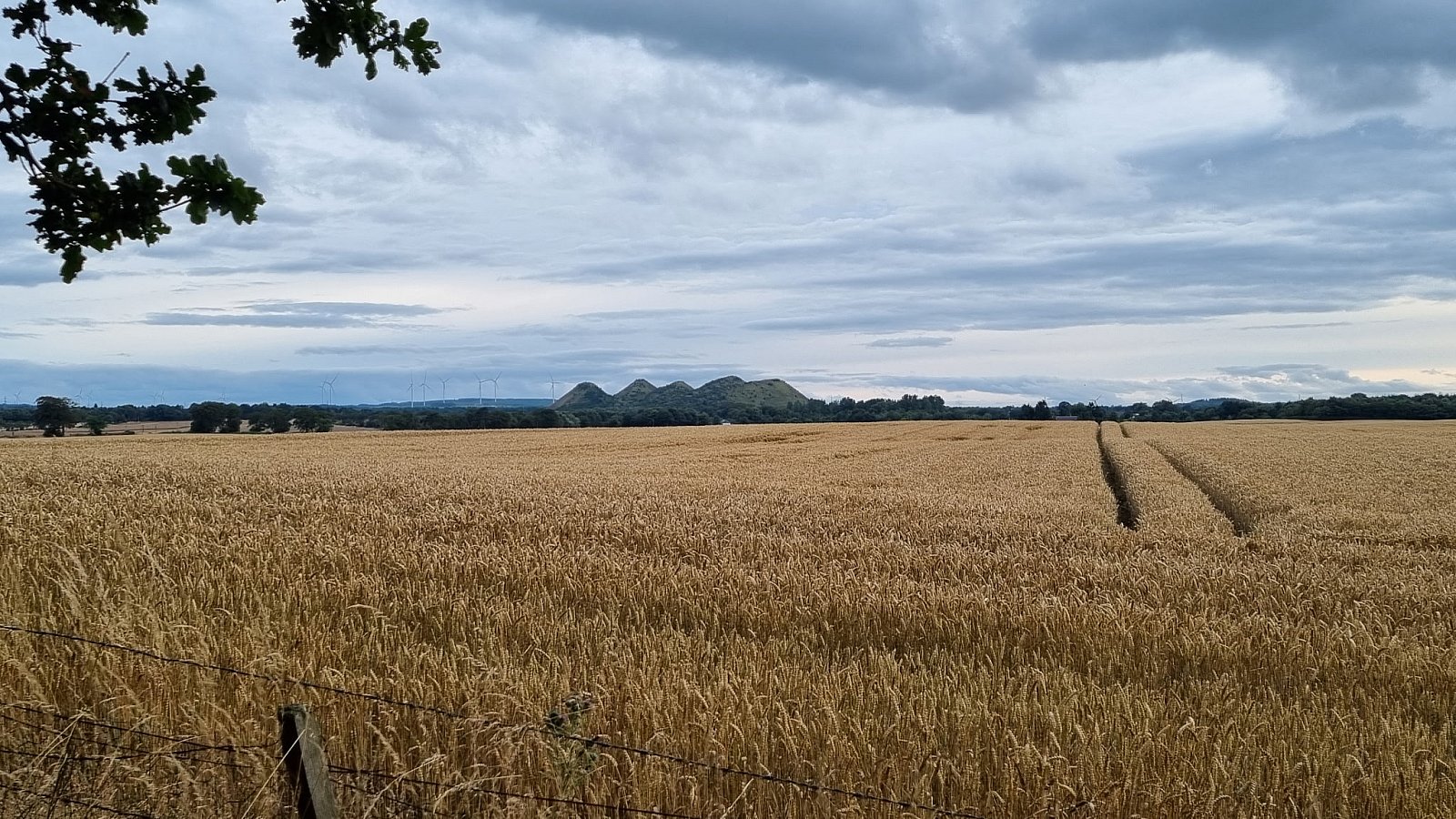
Leaving the river, we headed through woodland where there were views across the surrounding crop fields towards the Five Sisters Bing. Rising around 90 metres, the bing was formed from waste shale produced by the Westwood Oil Works — the last shale oil works ever built and is now a scheduled monument.
There was certainly a moment of disbelief when some of the group discovered that Westwood House, a Victorian/Jacobean-style mansion, lies buried beneath the southernmost bing. Not something you expect to find under a giant mound of shale!
From industry to innovation
Our route then took us across open land between the Killandean Burn and Kirkton Campus, providing an interesting contrast between Livingston’s agricultural and industrial past and its modern role in research, innovation and high technology.
We soon reached the Killandean allotments, where local residents, with support from the Climate Challenge Fund, had transformed what was once rough grassland into productive plots growing fruit, vegetables and flowers. Another example of people seeing potential in a piece of land and bringing it back to life for the benefit of the community.
Following the Killandean Burn, we eventually reached its meeting point with the River Almond and followed the river through parkland towards Livingston Village.
A wartime story of kindness
Our final historical stop was near the former Bloom Farm, opposite the site where, during the Second World War, long huts had housed German and Italian prisoners of war.
Here we heard a particularly touching story. Despite the hardships and uncertainty of wartime, many local families treated the prisoners with kindness, and genuine friendships developed between them. Remarkably, those friendships were remembered long after the war had ended.
As a gesture of gratitude, some of the former prisoners eventually returned to Livingston to give a concert for the villagers, thanking them for the compassion they had shown during such difficult times.
It was a fitting story to hear at the end of an evening which had, in so many ways, been about people: the farmers, mill workers, shale workers, volunteers, students, residents and communities who have all helped shape Livingston.
Just a few steps further along the street, we arrived back at the Livingston Inn, where our walk had begun.
Livingston through fresh eyes
By the end of the evening, I think we had all seen Livingston a little differently.
It is easy to think of Livingston simply as a modern New Town, but beneath that modern appearance lies a remarkable story of agriculture, industry, innovation, resilience and perhaps most importantly, community spirit.
From a centuries-old mill that was saved from demolition, to a landscape transformed from shale mining, to allotments created by local residents, and wartime friendships that endured across generations, the evening reminded us just how much history can be hiding in plain sight.
Some of the group had to head straight home, but the majority of us stayed on to enjoy a well-earned drink and a bit more socialising. After all, walking is thirsty work and nineteen Ramblers had certainly earned it!
Thank you to everyone who came along and helped make it such an enjoyable evening, and especially to those who shared their knowledge and stories along the way. Photo credits: John M & Nat C
Our next evening walk is on Thursday 20th August. Details of this walk, along with many more opportunities to get out walking with the group, can be found in the walk programme on our website.
Natalie C