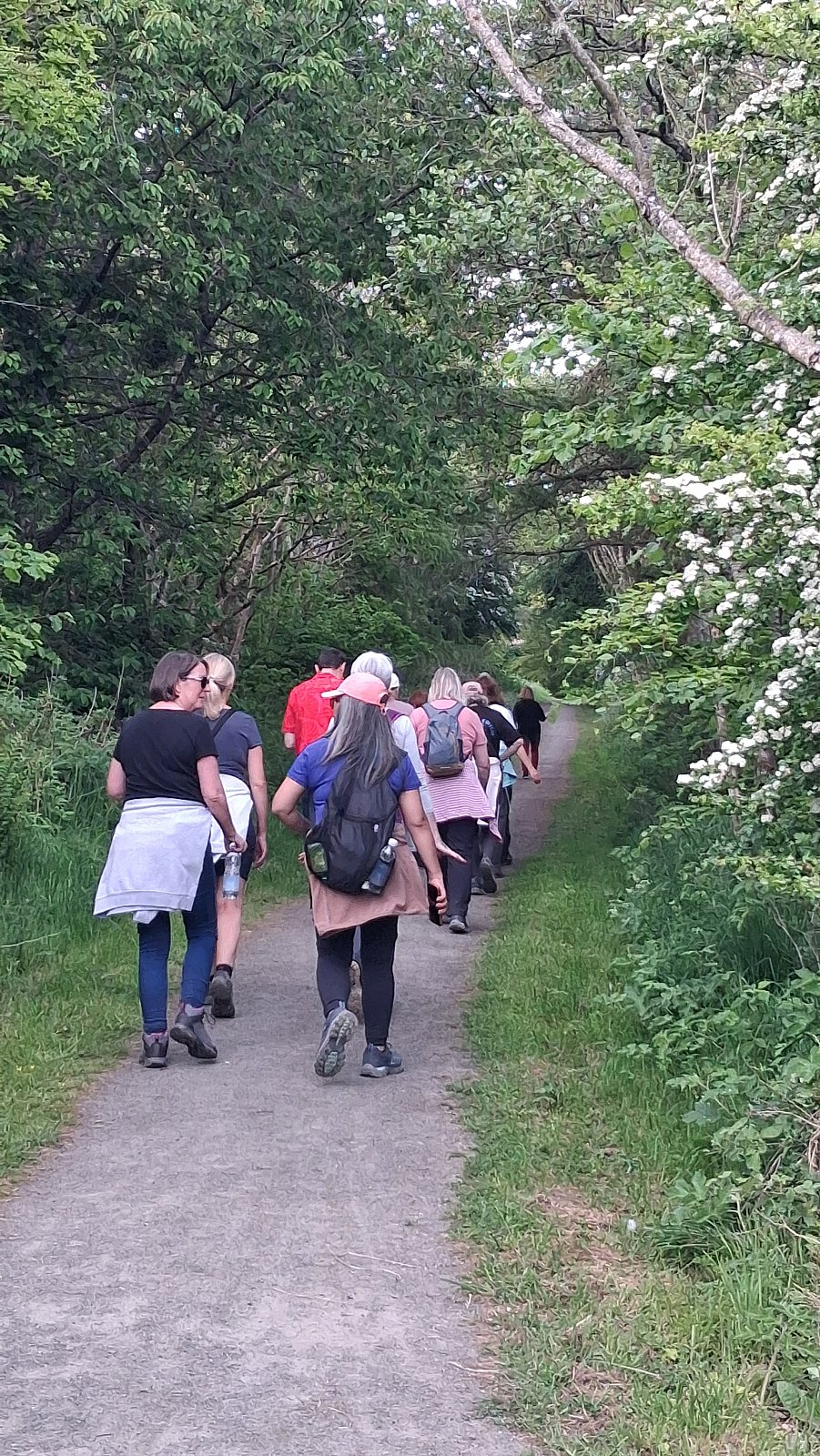
With warm sunshine continuing into the evening, the group gathered in great spirits for another chance to explore more of Livingston’s hidden paths and fascinating history. After welcoming Carol and Karen on their first walks with the group, we set off from Livingston South Station eager to discover what the evening had in store.
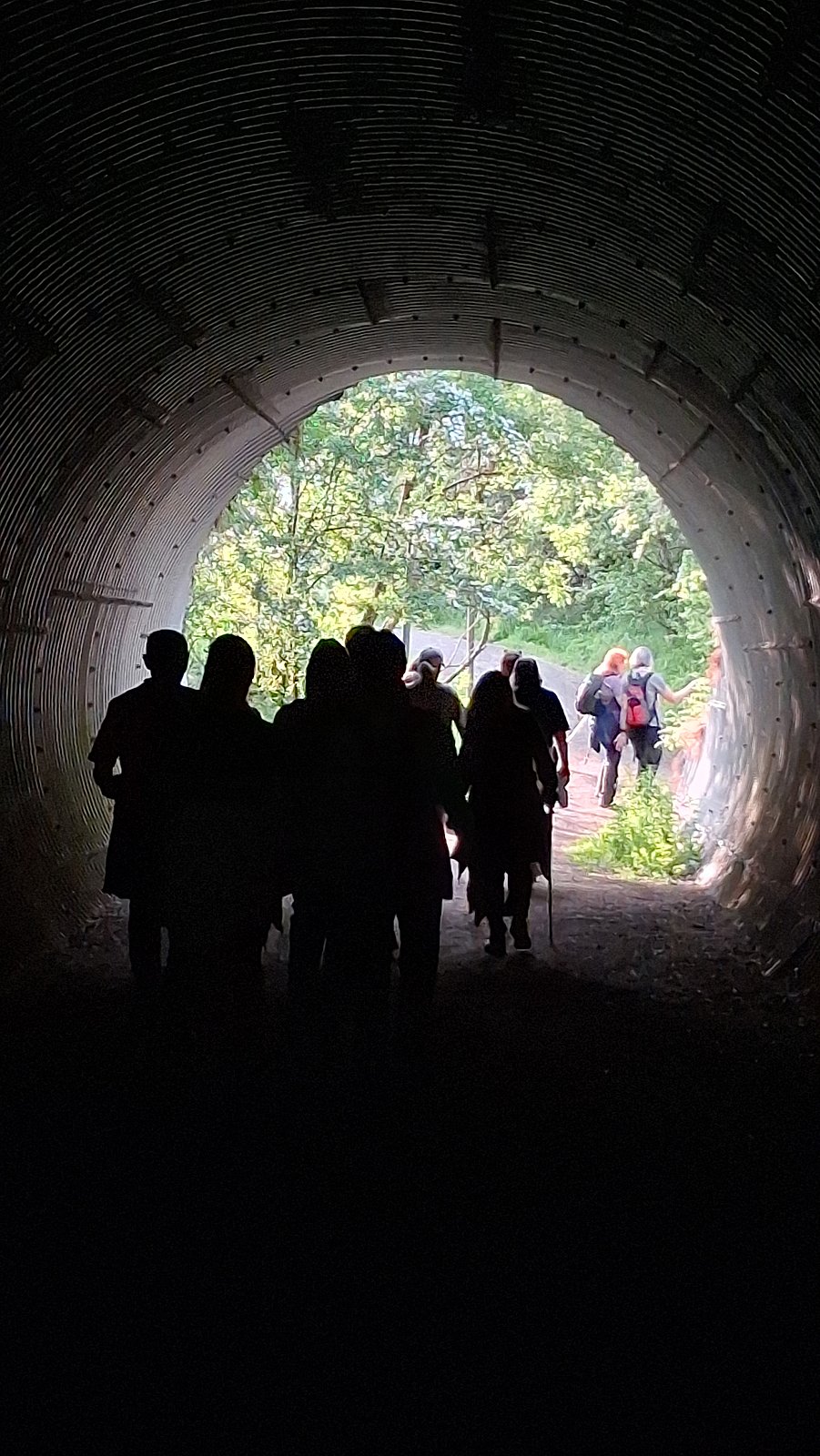
It did not take long for the first interesting fact to appear, as we learned that Livingston South played a small role in Scottish railway engineering history being the first station in Scotland to use the patented fibreglass “Dura Platform” system. Passing through the old cattle creep beneath the railway embankment, now adapted as a subway, we climbed towards Robins Lane, named after former Livingston MP and Foreign Secretary Robin Cook.
Crossing the Murieston Water, we reached the peaceful surroundings of the Linhouse Circular. It was hard to imagine that this attractive green space had once been farmland and later an industrial dumping ground linked to the shale oil industry. Along the way we heard how Contentibus Farm supported local communities during the Second World War, while local farmer Jock Ross continued delivering milk by traditional horse and cart during the rationing years.
The industrial history of the area also left its mark here, with waste shale from the Oakbank Oil Works once forming a huge bing across much of the landscape. In an interesting twist, much of that material was later reused during construction of the M8 and M9 motorways.
At Linhouse Glen we paused to admire the impressive six-span railway viaduct, completed in 1842 as part of the Caledonian Railway route between Carstairs and Edinburgh. Today the glen is protected as a Nature Reserve and Site of Special Scientific Interest, where ancient geology, woodland wildlife and industrial heritage now sit side by side.
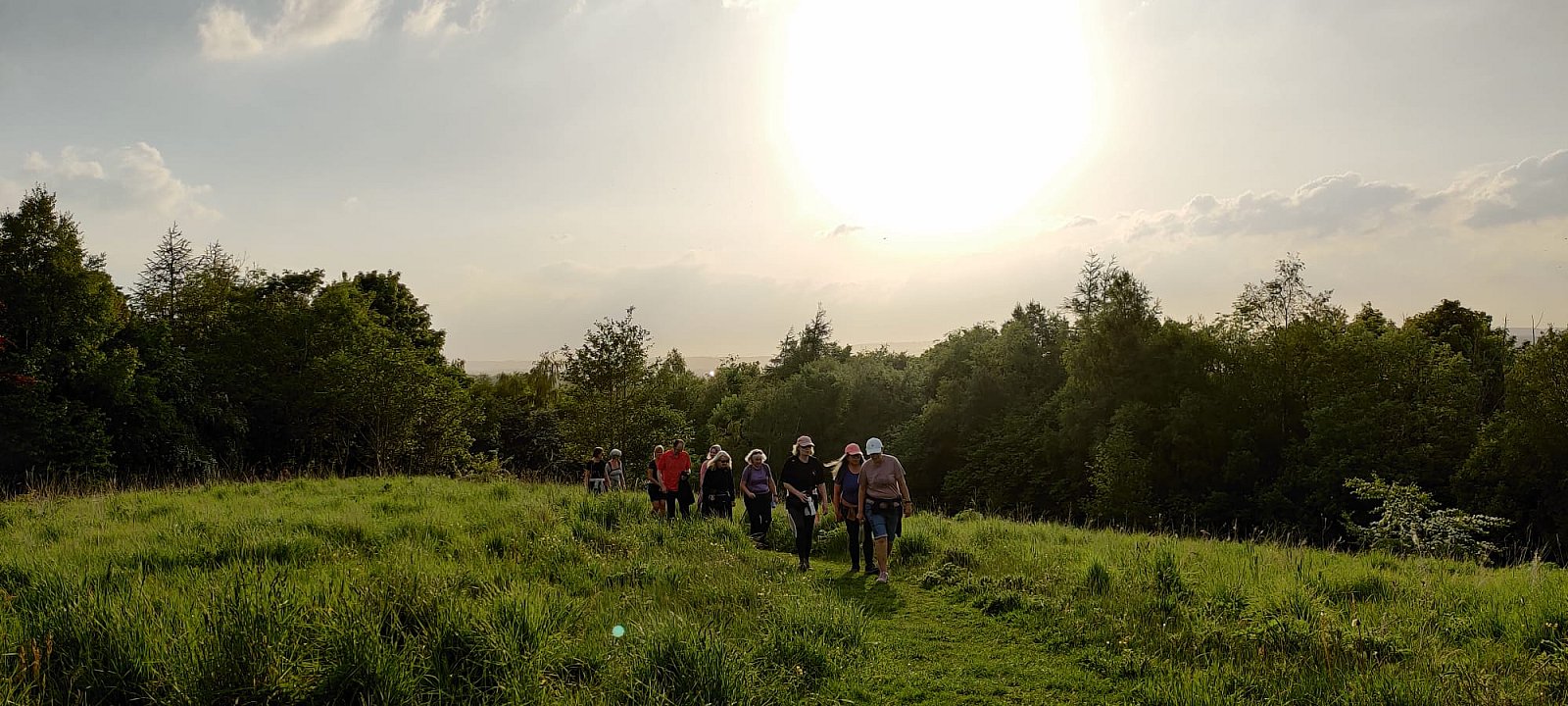
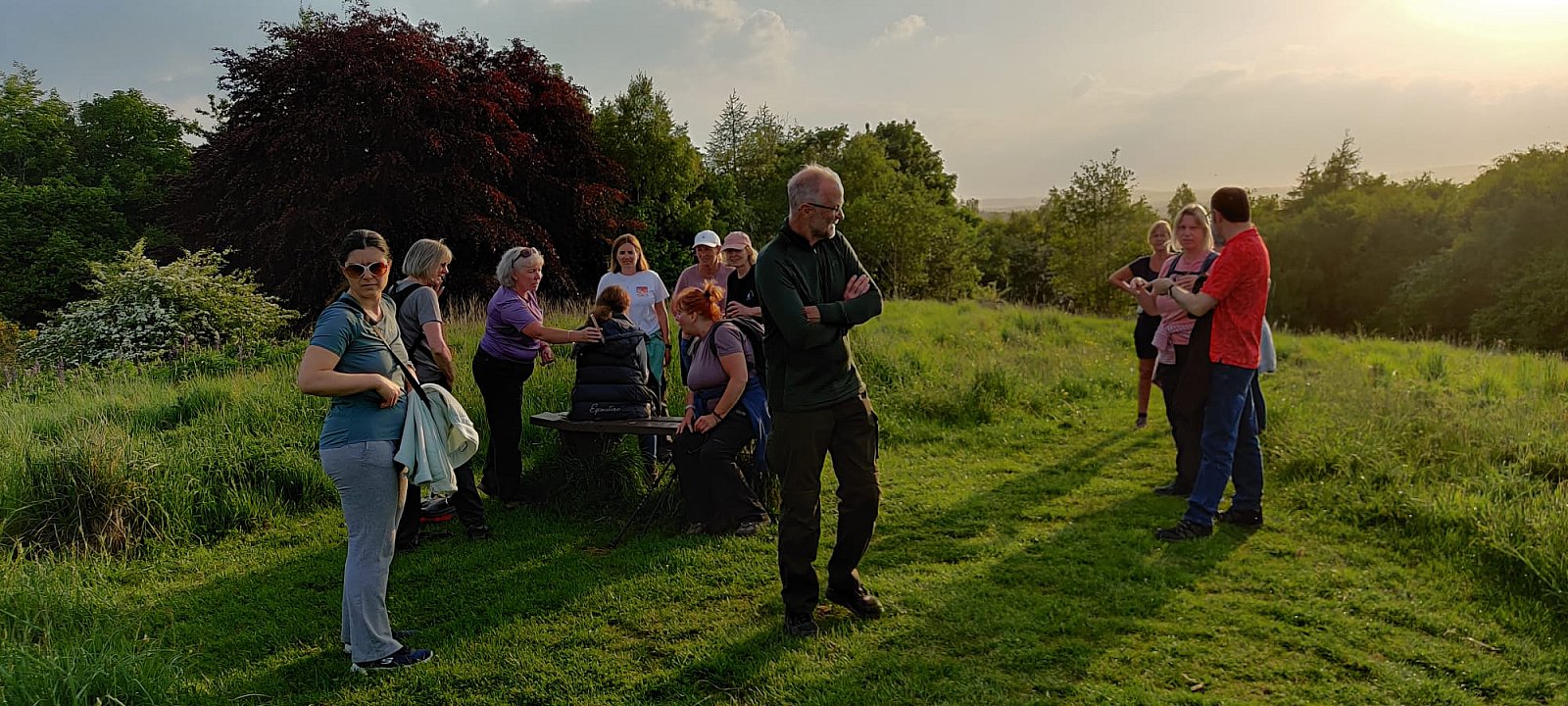
Our route then took us beneath the railway and through the long tunnel under the A71 before climbing steadily through woodland to the summit of Oakbank Bing. The effort was rewarded with wide views across Livingston and beyond, providing the perfect place for a refreshment stop in the evening sunshine. Wild lupins and other flowers were beginning to brighten the paths, with plenty more still to come in the weeks ahead.
Here we learned more about the lost Oil Village of Oakbank, once a thriving shale oil community built around the Oakbank Oil Works established in 1864. At its peak the village had its own school, clubs, sports facilities and shops, creating a busy industrial community in what is now quiet woodland. One particularly memorable story involved the aerial ropeway machinery installed from Germany in 1910, whose maker’s nameplates were quietly removed during the First World War to avoid anti-German hostility.
Although the oil works closed in the 1930s, the village survived for decades afterwards before gradually disappearing completely by the 1980s. Today the former industrial landscape has been transformed into peaceful woodland, wildflowers and nature reserve — one of West Lothian’s great examples of regeneration within a single lifetime.
Crossing the bing eastwards, we descended onto the old mineral railway before following paths beside the Murieston Water through Ian White’s Wood, named in memory of a highly respected Forestry Supervisor with the Livingston Development Corporation.
By the time we returned to Livingston South Station, we had once again discovered how many layers of history can be hidden within ordinary woodland paths and green spaces. From Victorian railways and ancient geology to vanished villages and modern conservation projects, this was another enjoyable evening of walking, stories, sunshine and good company. Photo credit - Ina G & Nat C
Our next evening walk takes place on Thursday 11th June. Details of this and many other walking opportunities can be found in the Walks Programme on our website.
Natalie C