With the wind picking up and the forecast predicting heavy rain showers, all fourteen Ramblers wrapped up warmly against the elements and met at Wester Inch, determined to get some fresh air and steps in.
Before setting off we learned a little about the background to the development of this relatively modern village and its connection to one of Bathgate’s most famous people. Planning permission was granted by West Lothian Council in 2003, and builders soon moved in to create a mixture of residential housing to meet local demand. Among these homes, Simpson Primary School was built to provide education for the younger residents. It was named after Sir James Young Simpson, the doctor who discovered the anesthetic properties of chloroform and introduced it for medical use in the 1800s.
Eager to keep warm in the icy wind, we set off at a brisk pace, passing several ponds which, together with the surrounding reed beds and vegetation, have become valuable habitats for wildlife including ducks, geese and swans. These ponds also play an important role in managing excess rainwater — storing it, naturally filtering it, and releasing it slowly to help prevent flooding.
Our route continued along National Cycle Route 75 through Bathgate Meadows Nature Park where, if you are lucky, you might spot the bushy tail of a fox or even a roe deer. This evening, however, all was quiet, so we continued beside the railway line until reaching residential housing. Following the pavements, we headed up a quiet lane before rejoining the modern housing estates of Wester Inch once more.
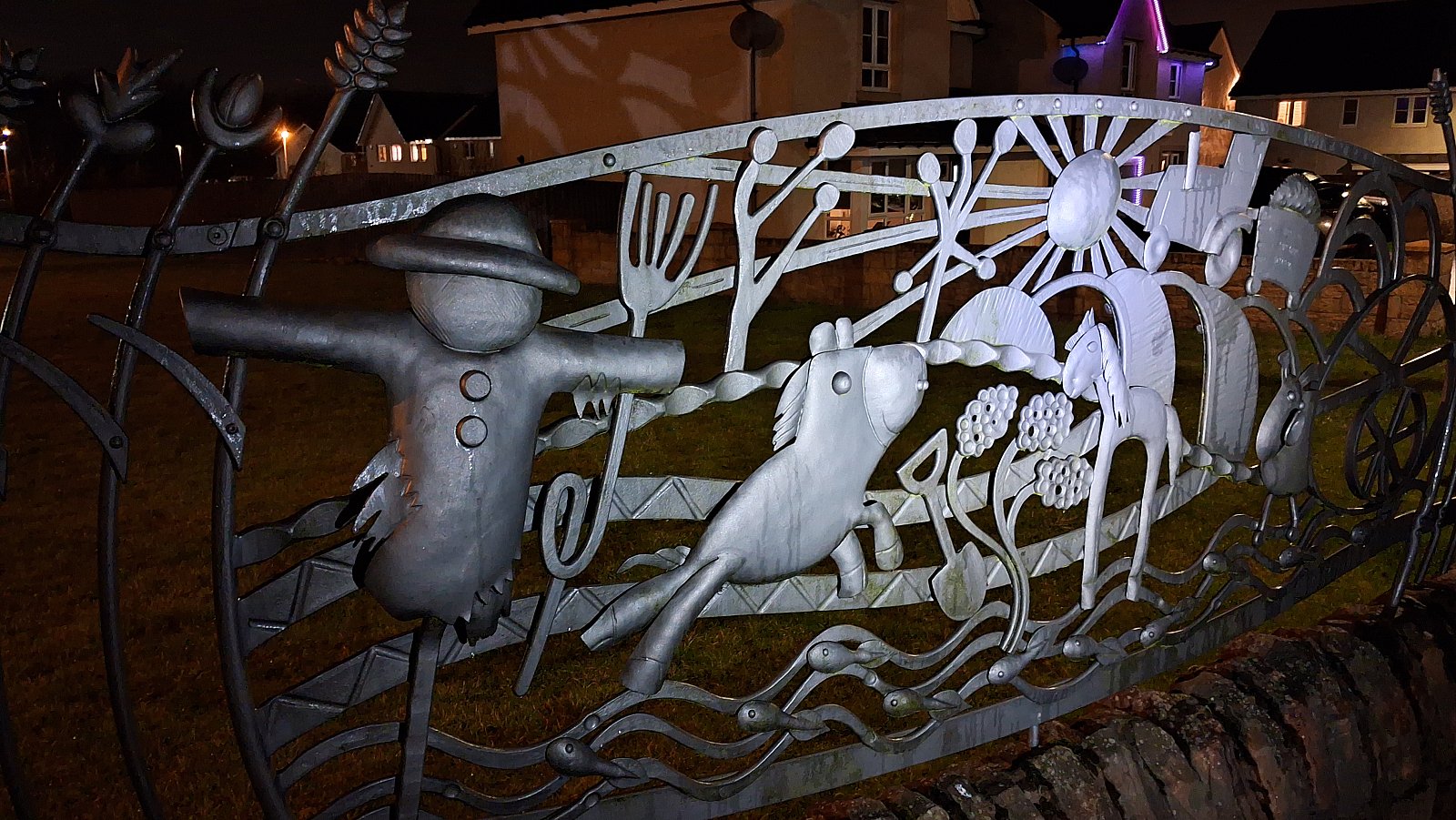
Just before crossing a road, we paused to admire the metalwork on a wall at the entrance to Lang Drive, which celebrates the area’s former agricultural landscape. It was lovely to hear from one of the Ramblers on the walk, who used to live nearby, that local schoolchildren had been involved in the design.
Having been fortunate with the weather so far, we decided not to test our luck and didn’t linger long before continuing along quiet paths beside residential housing built on the former site of industrial plants, including the British Leyland factory and the BMC (British Motor Corporation) lorry plant. These factories provided much employment in the area until the plant closed in 1986. The area once looked like a vast car park, with rows of brand-new lorries waiting to be transported.
Walking beside Bathgate Golf Course we passed the ‘Bathgate Face’. Designed by artist Lumir Soukup, rubble from the old factory was shaped into a giant human face based on measurements taken from over 1,200 of the local residents. Best viewed from above to clearly see the facial features, walkers were advised to search online for aerial photographs of the Bathgate Face.
Just before returning to our cars, we passed some large daisy sculptures which form part of the series In Full Bloom, created in 2012 by artist Martin Heron and located at various points around Wester Inch.
Despite getting a little wet on this evening’s walk, we all agreed it had been lovely to get out, enjoy each other’s company, and appreciate that although Wester Inch appears to be a modern housing area today, it actually sits on land with an interesting blend of industrial history, environmental regeneration and community creativity. Photo credit – Nat C
Our next evening walk is on Thursday 19th March & details of this along with many more walking opportunities with the group can be found in the walks program on our website.
Natalie C