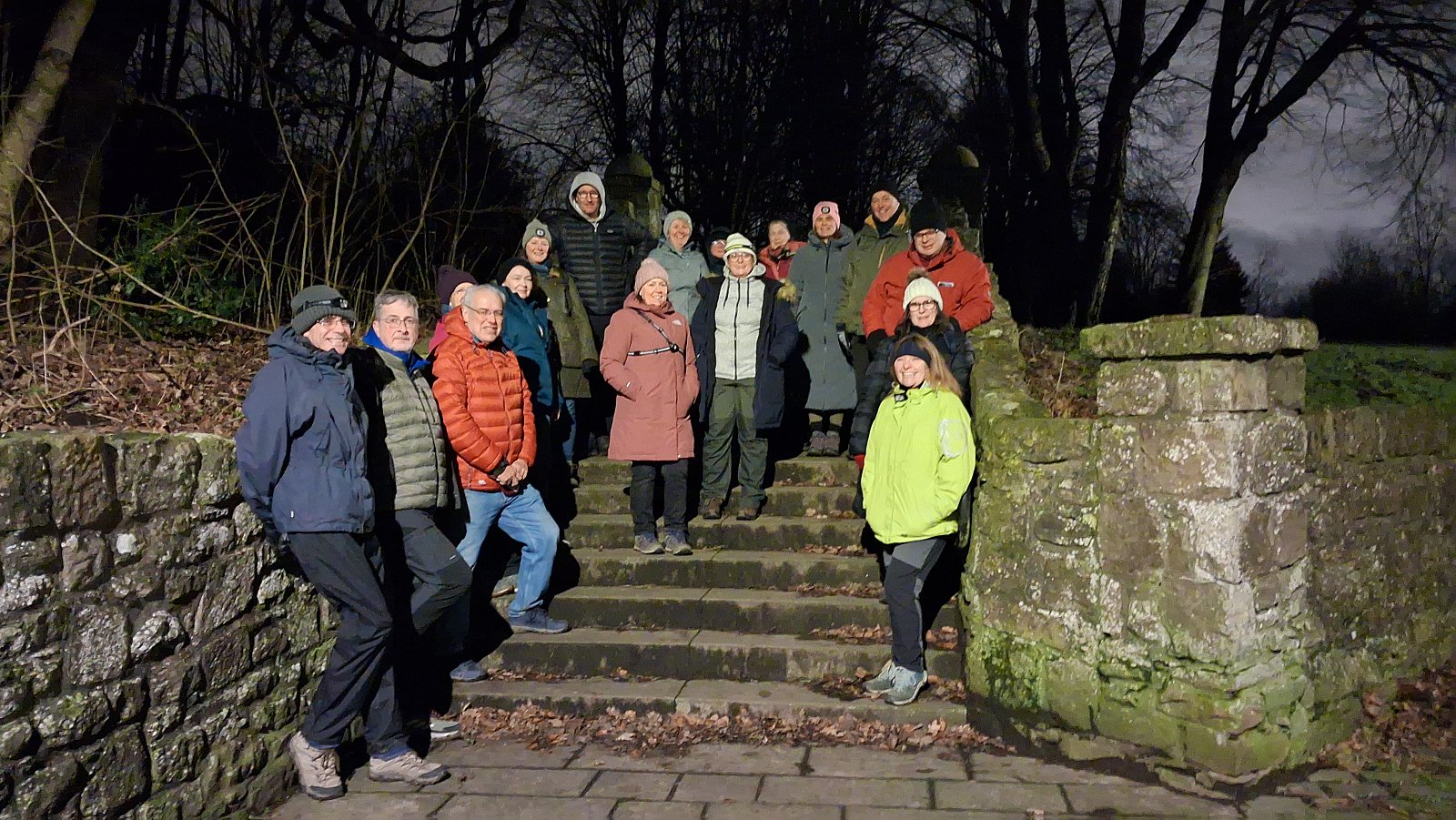
Despite a chilly forecast, it was great to see twenty Ramblers wrapped up warm and ready to venture out for our evening walk. After welcoming Pamela on her first walk with the group & making introductions, we set off alongside the Nell Burn, soon reaching the shelter of the trees surrounding Eliburn Reservoir.
Pausing briefly, we learned a little of the reservoir’s past. Created when the Pumpherston Oil Company dammed the Nell Burn, the water once supplied the local shale oil works & was originally known as Deans Reservoir. Today, this four-acre stretch of water is a popular fishery managed by the West Lothian Coarse Angling Association, home to carp, roach, rudd, bream and perch. It also attracts a variety of birdlife and, this evening, we could hear mallards calling while a family of swans glided quietly across the water.
Continuing along the reservoir, we passed through Eliburn Old Wood. The mixed woodland was originally planted in the 1880s as shelter belts to protect nearby farmland. Although quiet on this winter evening, the woods are full of life & it is common to spot squirrels in the trees, deer moving through the undergrowth and, in warmer months, the constant sound of birdsong.
Leaving the park, we followed quiet paths & stepped off the National Cycle Network to pass through a line of trees into Barracks Farm Field. Today it is an open field known for its biodiversity and valued as a wildlife haven. The landowners have kept the field as a nature reserve & with their permission, a dedicated local group works closely with nature organisations to protect the wildlife, care for the burn & enhance biodiversity. As Livingston, like many towns, continues to expand, we all agreed on the importance of protecting these vital green spaces.
Barracks Farm Field also has a fascinating past. As its name suggests, in the 1700s this was not farmland at all but a barracks housing dragoons & cavalry soldiers during the Jacobite uprisings — a military presence keeping watch over West Lothian in turbulent times. By the mid-1800s, once the area had settled, the land became part of a working farm owned by the Earl of Rosebery. Its location on the edge of the Deans oil shale fields meant that small-scale shale mining took place here in the 1860s. To the group’s surprise, by the early 1900s the land had become Livingston Golf Club, complete with a railway carriage as their clubhouse.
Our route took us around the field & out at the far end, where we joined paved paths beside the Lochshot Burn. Before reaching Livingston Village, we headed uphill through woodland to Peel Park — the birthplace of Livingston itself. Here the land was granted by King David I to a Flemish nobleman, de Leving, in return for military service. At the park’s highest point, de Leving built a fortified tower house surrounded by a moat. Drawn by employment & protection, servants, workers & families settled nearby, forming Leving’s toun, which gradually evolved into Livingston. The family prospered & eventually became the Earls of Linlithgow, keepers of Linlithgow Palace.
The Peel & its lands later passed to the Murrays of Elibank. One member of the family, Patrick Murray, laird of Livingston in the 1600s, left a remarkable legacy. A passionate plant collector, he travelled across Europe gathering around 1,000 species & created an extraordinary garden here. Described as “one of the most promising men of science of his time”, his work inspired friends Robert Sibbald and Andrew Balfour — leading Scottish physicians & botanists — to establish a medical garden in Edinburgh. When Patrick Murray died at just 35 while in France, he bequeathed his precious plant collection to Andrew Balfour. The plants were painstakingly removed, cartload by cartload & eventually found their permanent home in the Royal Botanic Garden Edinburgh, where they remain today.
Although the garden & peel no longer exist, the footprint of Livingston Place — a manor house built by Patrick’s nephew — can still be seen. Walking past this, we descended to a lower path & exited the park. Passing through residential streets, with names ending in “Place” hinting at old field boundaries, we made our way back towards Eliburn Old Wood & followed paths leading once again to the reservoir. This time we walked along the opposite shore, returning to the Nell Burn where our walk began.
Just before saying our goodbyes, the clouds parted briefly to reveal a star-filled sky. Orion’s Belt was quickly spotted before the cloud cover returned — a fitting end to an evening that reminded us that, although Livingston is often described as a modern New Town, beneath its paths lie over 900 years of stories. You just have to be curious & know where to look. Photo credit Nat C
Our next evening walk is on Thursday 19th February & details of this along with many more exciting walking opportunities can be found in the Walk Programme on our website.
Natalie C