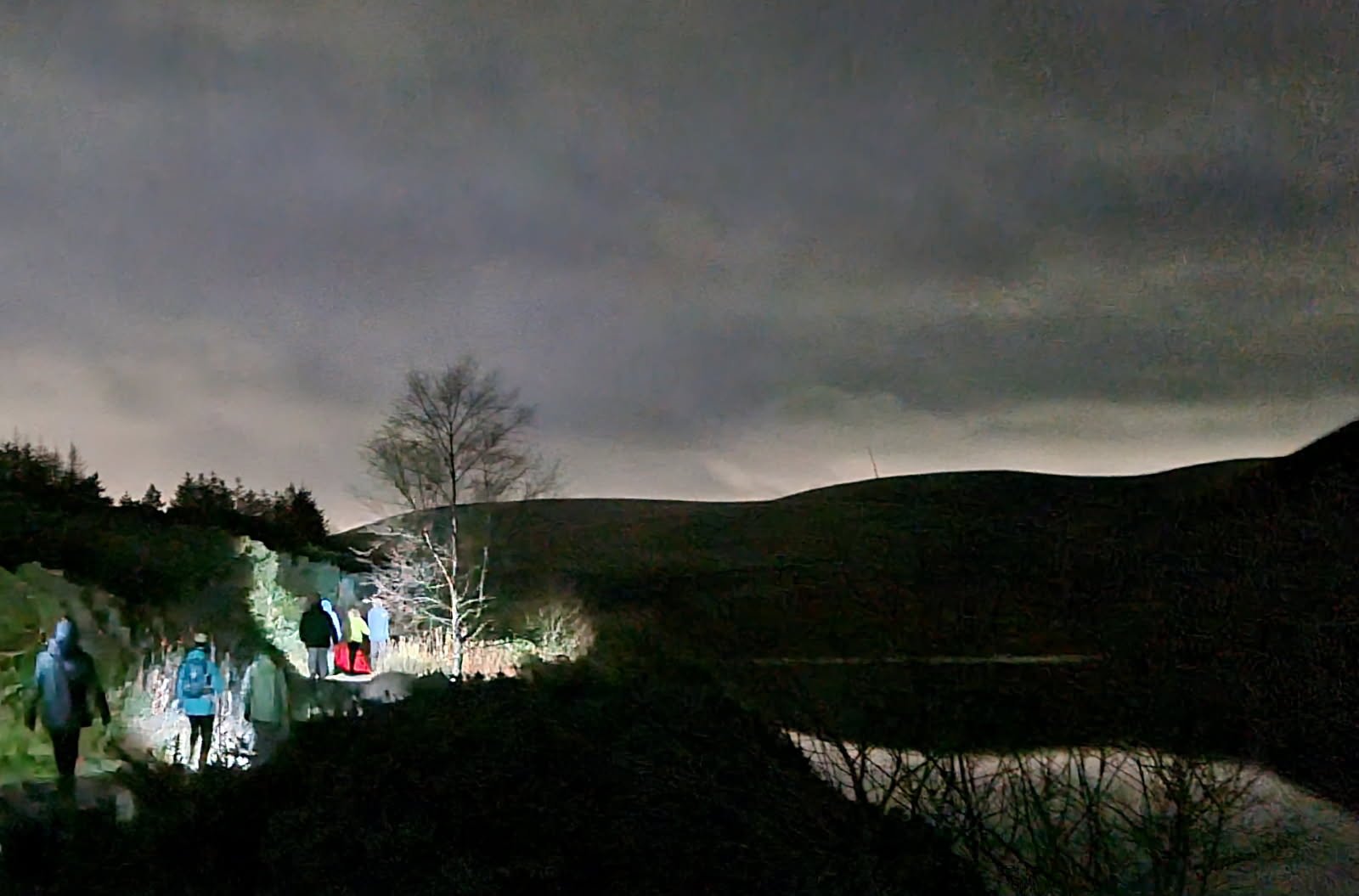
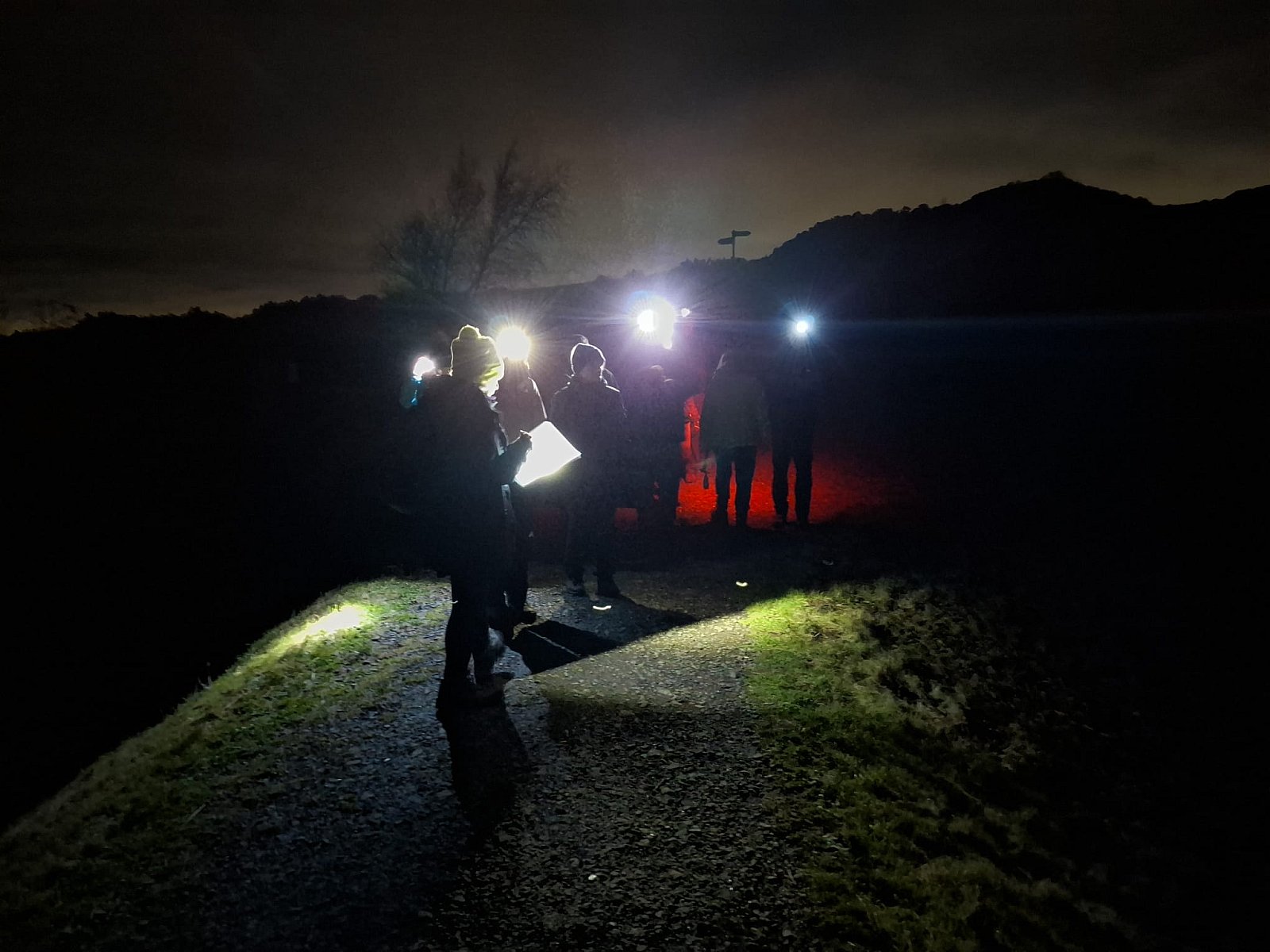
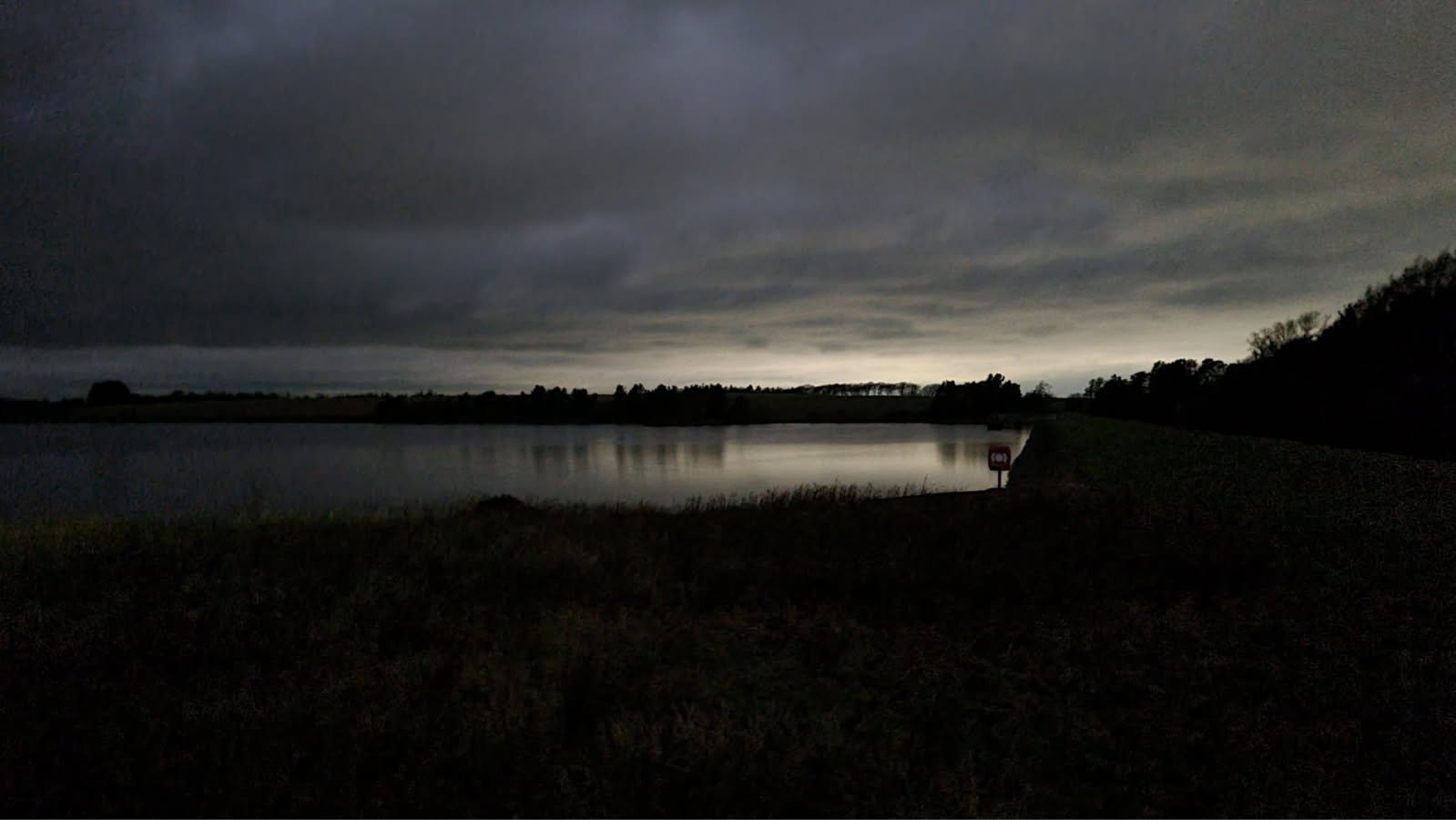
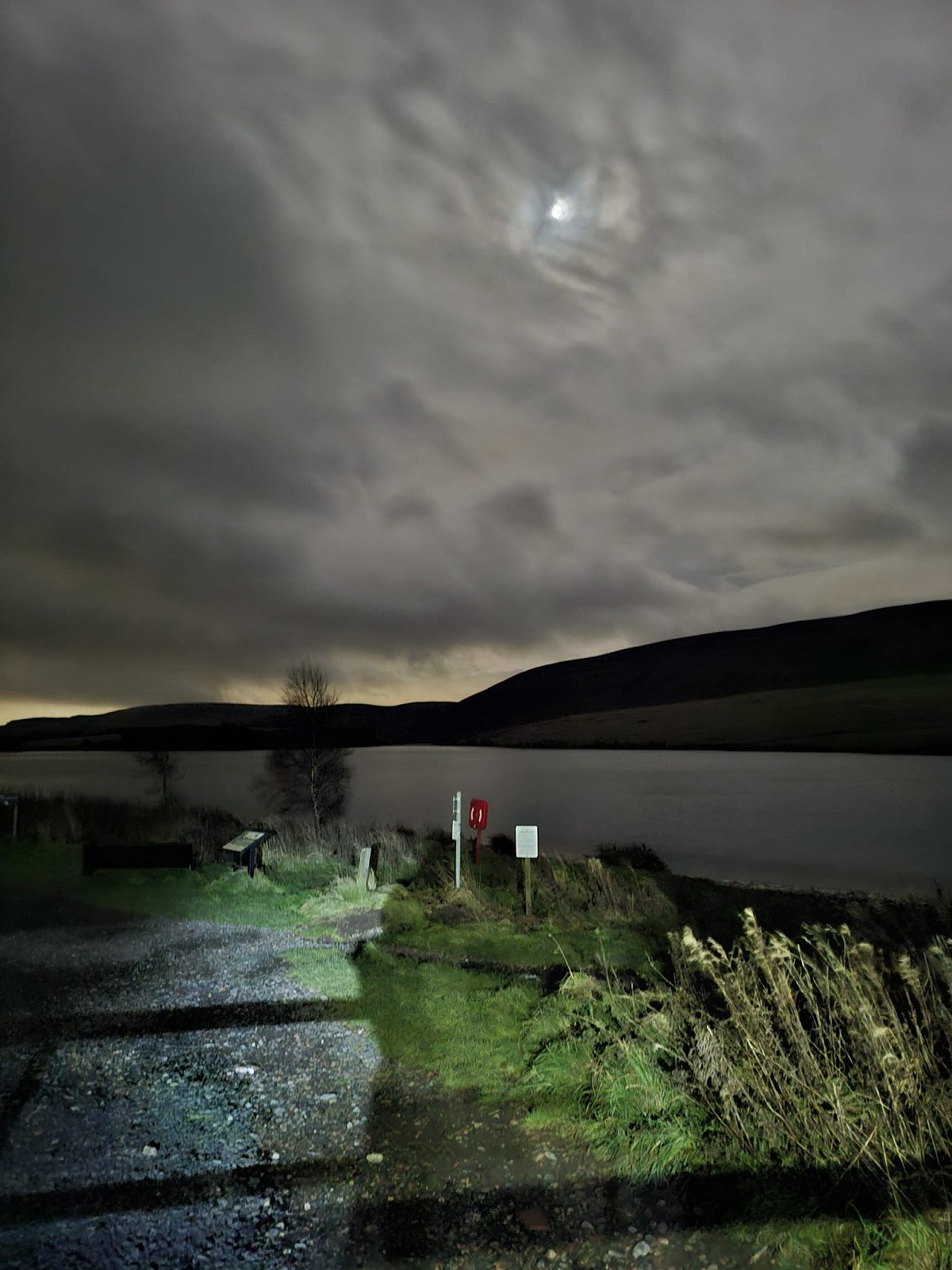
Eleven Ramblers set off from the car park at Threpmuir this evening & it was lovely to welcome some members on their first evening walk with the group. With 99% cloud cover we were assured a mild evening, although it soon became clear we were unlikely to enjoy any star-spotting or views of constellations. Undeterred, we followed the path alongside Threpmuir Reservoir. For a brief moment the cloud cover broke, allowing us a glimpse of the moon. Its reflection lit up the surface of the reservoir before once again disappearing into darkness.
Along the way we learned something of the history of the two reservoirs. Built in the 1840s by the Edinburgh Water Company, not as drinking water sources, but to power the mills along the Water of Leith, Threpmuir and Harlaw each have their distinctions. Although Threpmuir stretches across a larger surface area, it is comparatively shallow at only 5.2 metres deep. Harlaw, by contrast, reaches a depth of 16.5 metres and has steep sides, certainly not somewhere you would want to take an accidental dip!
During World War II these peaceful waters unexpectedly became part of national defence measures. Wooden poles were installed in the surrounding fields to prevent enemy aircraft from landing & additional poles were driven into the reservoir bed. Large pyramid structures were also built to deter sea planes from landing on Threpmuir. However, no such measures were taken on Harlaw reservoir as it was decided that the smaller surface area& the fact it was surrounded by the fringe of trees was enough of a deterrent, preventing any aircraft from using it to land. German bombers used these two reservoirs as a marker to guide them as they crossed the region on their way to attack ships in the Firth of Forth during early battles of the war.
Our route led along the side of the reservoir where thankfully with potholes had been recently filled, sparing us any unexpected puddle-wading, before we walked across the base of the dam & into the woodland at Black Springs. This quiet corner forms an important wildlife sanctuary, offering shallow waters, reeds & wet grassland for waterfowl, amphibians and insects. It holds strong populations of reed buntings & warblers & is the second largest reedbed in the Lothians after Duddingston Loch. In the dim evening light, we could just make out a pair of swans on the water.
Climbing above the wildlife refuge, we made our way between a band of trees once more before descending towards Harlaw Reservoir. Here, light pollution from Edinburgh was visible in the cloud cover & we could see red aviation obstruction lights rising vertically over the Firth of Forth. These lights, mounted on the bridges' towers, reflect in the low clouds to assist aircraft navigation, clearly doing their job on a night like this.
The final leg took us down the side of Harlaw before retracing our steps back alongside Threpmuir to the car park. The evening was so peaceful, calm & still. Although we weren’t fortunate enough to see the stars, everyone agreed it was a lovely night to be outdoors, enjoying the company & learning a little more about this fascinating part of the Pentland Hills Regional Park. Photo credit: UT & John M
Our final evening walk of 2025 is on Thursday 18th December & details of this together with more evening walks in January 2026 can be found in the Walk Programme on our website.
Natalie C