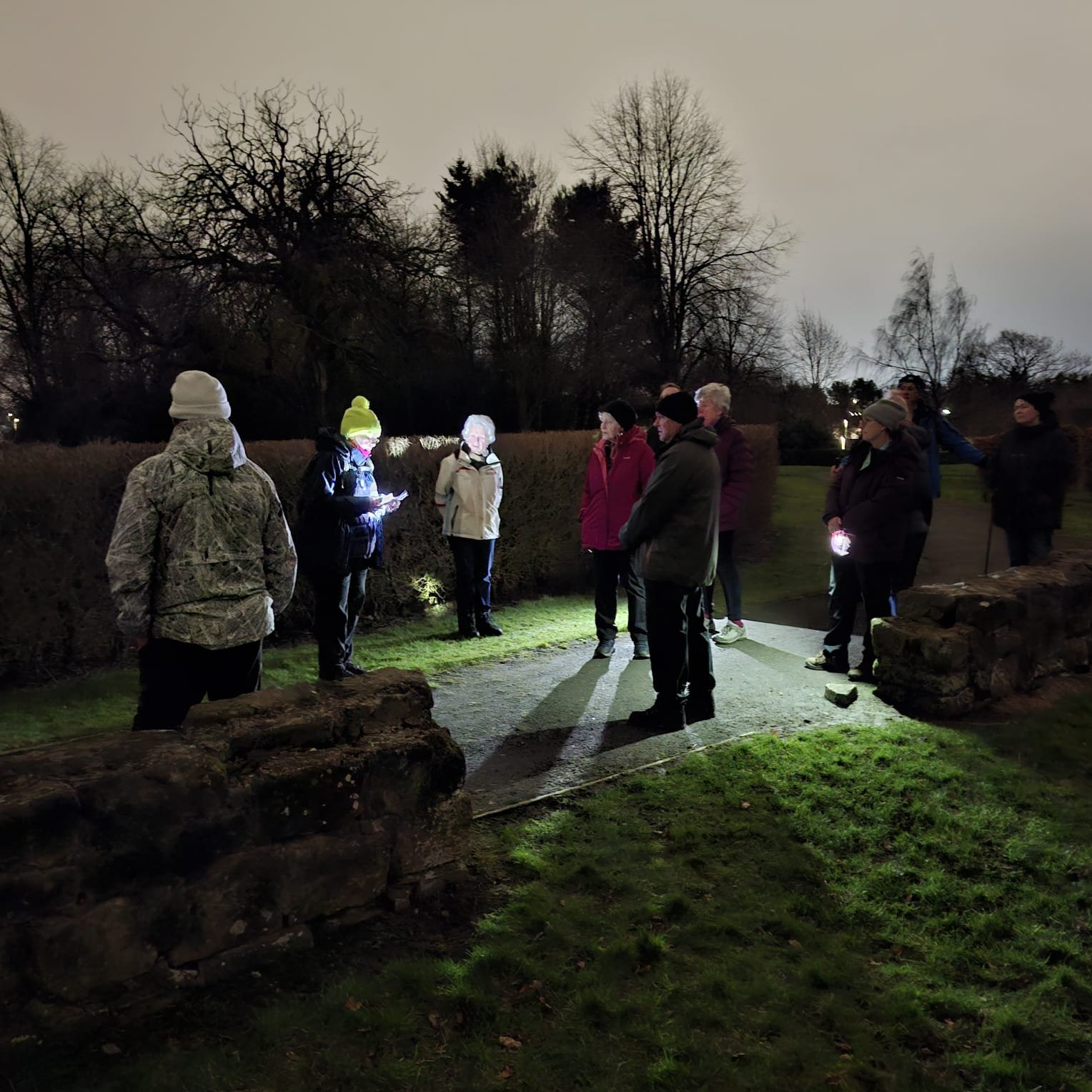
A lovely spring like day today & although it clouded over this evening the rain held off while we were walking. The cloud made the evening dark, but it is not long now until the clocks change & we can enjoy a bit more light on our evening walks.
Our walk started from Livingston North Station & we followed the railway path & the Nell Burn to reach Eliburn Park. The burn had been dammed in the early 20th century by Pumpherston Oil Company to create Deans reservoir & the water was used to supply the shale oil works located nearby. The reservoir is now a 4-acre fishery stocked with various species of fish which many an angler enjoy the challenge of catching.
We learnt that the woods on either side of the reservoir having surrounded Eliburn for centuries date back to the early 1800s. Originally planted as shelter belts for fields they are managed to include areas of conifer for harvesting & mixed woodland (oak, beech, larch & Scots pine). These woods appear on old maps as simply ‘Old Wood’ & are home to a variety of wildlife & bird species.
The woods, reservoir & surrounding land which include a play park, football pitches & network of paths now make up Eliburn Park which is a popular destination for fishing & recreation.
Walking beside the reservoir we had to be careful as we came across lots of frogs making their way to the water’s edge. They paused in their tracks when under the spotlight of our head torches & sat head up alerted to the danger of our pounding feet on the path. Leaving them in peace our route dropped down to join the Lochshot Burn path where the overflow water from the reservoir runs down the slipway & rejoins the Nell Burn before feeding into Lochshot Burn where it continues its journey to join the River Almond in Livingston Village.
Before leaving the Eliburn area we stopped beside a Standing Stone circle. The outer stones encompass a large flat stone known as a recumbent stone or sacrificial stone. I’m pleased to say no person or thing was sacrificed on our walk this evening. Although Livingston dates back to the 1100s these seven stones date to a much more recent time. The reason & purpose of this circle remains a mystery however the consensus is that the Livingston Development Corporation added them between the path & river as a beautification scheme. It goes to show that not everything you see is as old as it looks!
When the new town of Livingston was built the LDC (Livingston Development Corporation) had a naming system for the streets. In Eliburn if a street ends in ‘Place’ then it is named after local historical field names. Examples of this are Oldwood Place, Lyefield Place, Ballantyne Place & Beech Place. If the street ends in ‘Crescent’ then it is named after a Scottish train station for example, Haymarket Crescent, Waverley Crescent & Buchanan Crescent.
Entering Livingston Village we stopped in Kirk Lane & learnt that there had been a church located here since the 12th century. The current Kirk however is a replacement having been built in 1732 after the original one was destroyed in 1650 during the Cromwell Invasion.
The Kirkyard has some interesting history & so we took a few minutes to look at & discuss these. Although we don’t know where about in the churchyard she is buried, Lady Marie Livingston, nee Hamilton who was one of Mary Queen of Scots 4 ladies in waiting was buried here circa 1530.
There are a pair of curious stone pillars which have five holes drilled in the top in a quincunx pattern. These are known as ‘Punishment Stones’ & are believed to have been used to demonstrate public repentance. It is said that the sinful individual was asked to stand with their fingers in the holes, visible to parishioners entering the Kirk. Parish records confirm details of people called to repentance by the Kirk Session for their actions. It is only after having repented publicly that the individual was re-admitted to the Church.
The war memorial just inside the gate has the inscription ‘Scared to the memory of the employees of the Deans Works who died in the Great War. Erected by their fellow workers.’ No doubt, we will discover more about the Deans Works & its employees on our next evening walk in the Deans area of Livingston later this month.
Entering the centre of Livingston Village we learnt that this area, before 1962 when the new town was created, was simply called Livingston & was named after the Leving family who controlled the area until the family died out in 1512.
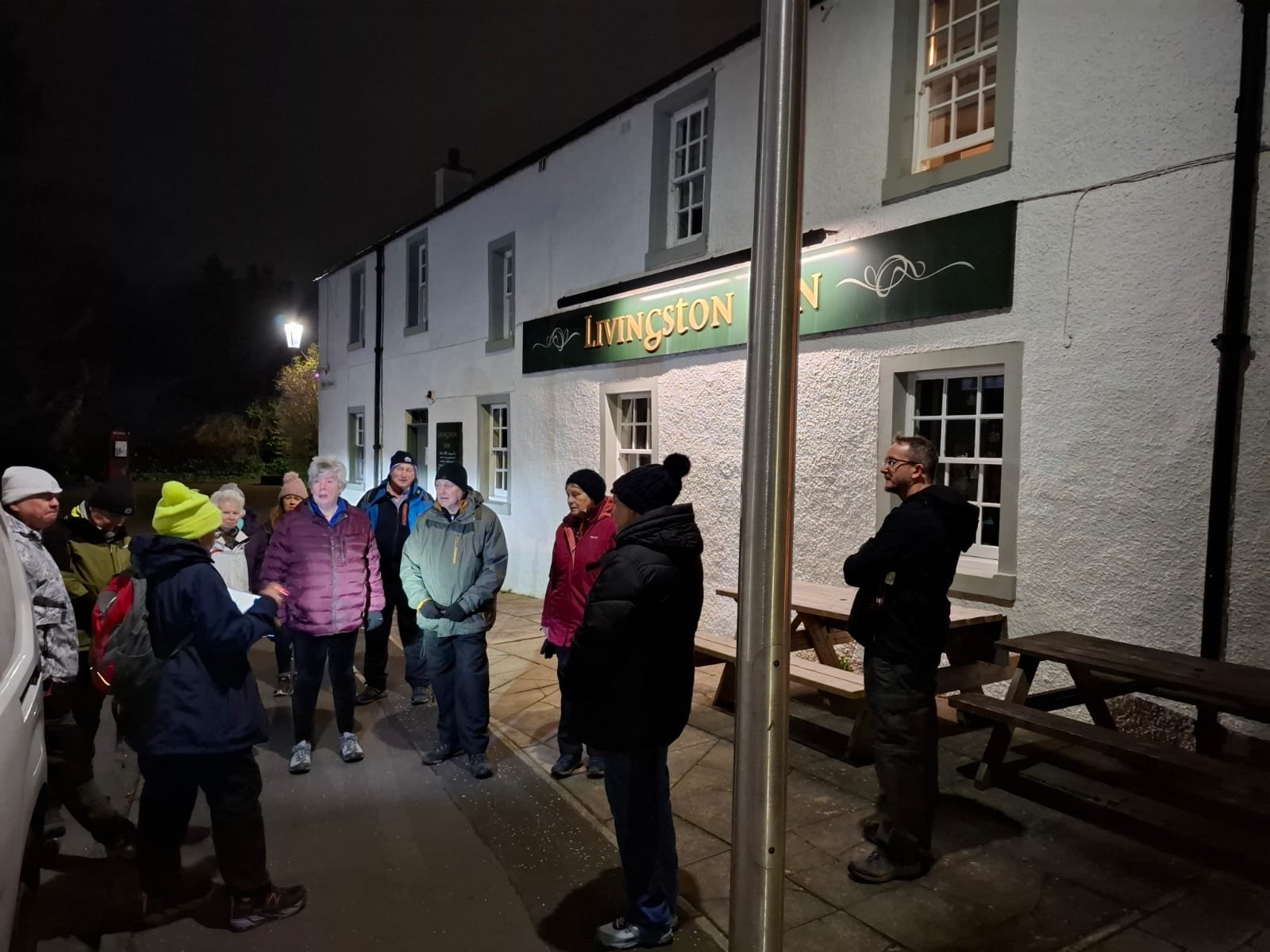
Livingston Inn is a focal point in the village & was built in 1760 as a coaching inn on the main Edinburgh to Glasgow route was one of a few inns providing fresh horses for the coaches & refreshments for the passengers. We learnt that by 1780 these welcome facilities enabled the ‘Edinburgh to Glasgow Flyer’ to complete the 50-mile journey between the two cities in a little over 24 hours. A little hard to believe when we can do the journey today in 1hr 15mins!
We discovered that Robert Burns had been a famous resident & while staying here in the Inn, he had penned the song ‘The Bonnie Lass of Livingston’. The question we all had was – who was the bonnie lass?
Further along the main street we stopped beside some old farm buildings now repurposed into small business units. These building stand beside Bloom House & we learnt that in the 19th century Bloom House & Mill farm (known to us all now as Almond Valley Heritage Centre) were owned by Lord Rosebery. Tenant farmers worked theses farms & lived in the village.
Opposite the farm buildings in 1943, long grey huts were erected on the farmland to house 100 POW German & Italian soldiers who were billeted there. The village residents established friendships with the prisoners & due to this friendship & the kindness shown to them by the villagers many returned years later. One prisoner became a Minister & brought a choir & they, together with an orchestra made up of German prisoners played a concert in the Kirk to celebrate this friendship & acknowledge the kindness they had been shown.
Leaving Livingston Village our route took us back to Eliburn, entering Peel Park. Here we learnt more about the family giving Livingston its name.
In return for military service, de Leving, a Flemish nobleman was invited to Scotland by King David 1 & was given a grant of land. In 1124 de Leving built a fortified tower on a large, earthen mound & it was surrounded by a moat. This was surrounded by more humble dwellings which housed Levings servants who had been attracted by work & its protection. The settlement became known as Leving’s toun & over the years became Livingston. As we entered the park, we passed a street with the name Leving Place which of course links to the past & the de Leving family.
We learnt that the de Leving family prospered & went on to become the Earls of Linlithgow & keepers of Linlithgow Palace however as previously mentioned the family died out in 1512. The house & surrounding land was then acquired by The Murray’s of Elibank & they then resided in the tower house.
At this time, Livingston was huge but sparsely populated, around 2000 inhabitants. The area stretched 10 miles from Dechmont in the east to Fauldhouse in the west & was made up of mainly rough, open countryside, dotted with small patches of cultivated land & large areas of wet moorland like, Drumshoreland, Easter Inch, Whitburn & Fauldhouse moors.
The last inhabitant of Livingston Peel was Patrick Murray who had a passion for collecting & growing plants. He travelled across the world collecting seeds, plants & exotica & was described as ‘one of the most promising men of science of his time’. Having acquired 1,000 species of plants he created a physic garden in the grounds of his home. His invaluable collection became the foundation for today’s Edinburgh Botanic Gardens.
Unfortunately, Patrick died at the age of 35 of a fever while travelling in France. Two of Patrick’s friends, Robert Sibbald & Andrew Balfour were Scottish physicians & botanists who went on to found the Royal College of Physicians in Edinburgh. These friends had been inspired by Patrick’s garden to start a medical garden in Edinburgh, creating a place where supplies of fresh plants & herbs for medical prescriptions could be on hand & medical students could study botany.
Patrick bequeathed his precious plant collection to Andrew Balfour & so the massive task of digging up & transplanting the collection got underway. The plants were carefully moved cartload by cartload to an allotment they had rented in St Anne’s Yards, Edinburgh. This is where the public car park for Holyrood Palace is now located.
The garden flourished & more space was needed so five years later the collection was moved to a larger plot leased from the Town Council. This plot was next to where Platform 11 at Waverley Station now stands today & there is a commemorative plaque marking the spot. A final move to Inverleith Row in the 1820s & a change of name to Edinburgh Botanic Gardens completed Patrick Murray’s plants journey.
To commemorate Patrick Murray’s contribution to the natural science of botany, in 1995 the Livingston Development Corporation created a physic garden in Peel Park. Unfortunately, the physic garden is hard to see now however you can see clearly the box & yew hedging which gave structure & divided the beds.
From the park we followed the path beside Folly Burn to reach our start point at the station. Photo credit – U. Tiedemann
Our next evening walk will be on Thursday 20th March & details of this can be found on the walk programme on our website.
Natalie Corner