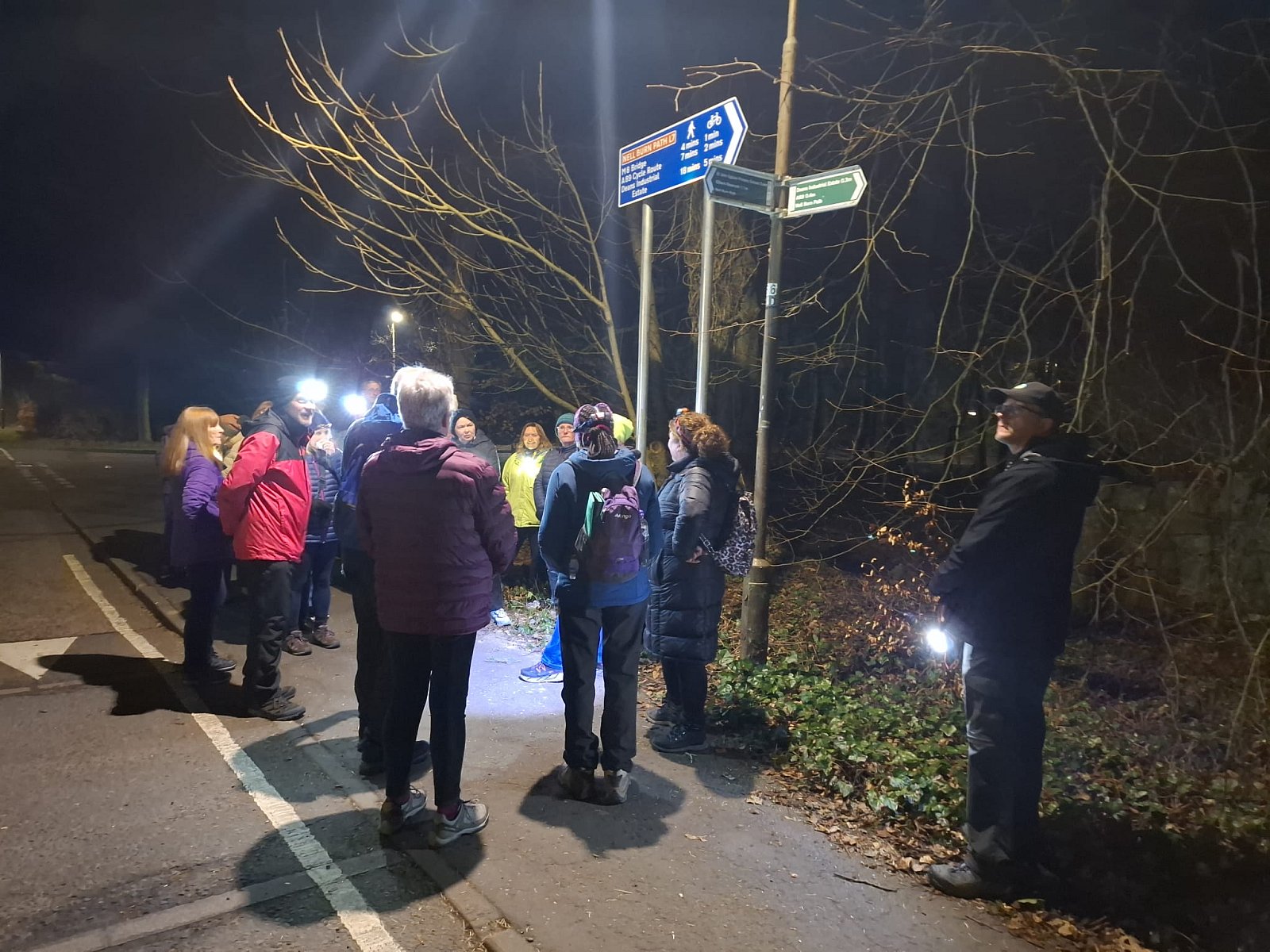
Today was the spring equinox so we had an equal amount of daylight & darkness. Days will now be lengthening & of course, we will make the most of them with our evening walks throughout the summer & autumn.
Tonight, twenty four Ramblers enjoyed a walk around the Deans area of Livingston & there was much to discover along the way as this area has changed beyond recognition from the largely agricultural land with little population, to a bustling mining community before undergoing more change with the demolition of the old village & housing to create the suburb of Deans as part of the new town of Livingston.
Before setting off from Livingston North Station we welcomed Pat & John out on their first walk with the group & learnt a little background about the area we were going to cover along the route including how Deans got its name.
Deans takes its name from the Deans Estate which once stood where Deans Industrial Estate & the Tesco depot now stand. The house Deans Mansion was owned by the Norvells, a Jacobite family & in 1745 Bonnie Prince Charlie & Lord George Murray, who was one of Bonnie Prince Charlie’s commanders during the ill-fated Jacobite uprising are said to have stayed. The remnants of the house & farm buildings no longer exist & are thought to have been buried underneath Deans Bing!
Originally Deans was known as Livingston Station & was named after the railway station on the Bathgate to Edinburgh line. This area was developed in the 1870s around the Bathgate railway & oil shale mining industry.
Walking beside the railway line it wasn’t long before we arrived in Deans & stopped outside the Livingston United Junior Football Club ground of Station Park. Founded in 1970 but the club had been in existence since 1915. Here we learnt that Livingston Station had been the birthplace of not one but three international footballers who won caps for Scotland: Willie Waugh, Tommy Walker & Jimmy Scoular.
Tommy Walker was the childhood idol of Tam Dalyell who wrote his obituary after his death in 1993. We heard the tale of how in April 1936 at Wembley Tommy became an indelible Scottish hero after scoring an equalising goal after England conceded a penalty. Two years later, back at Wembley again he scored the winning goal to beat England placing him firmly at the top of all hero books of footballers who had confronted the Auld Enemy.
Continuing along the road to reach the village centre we passed two of the villas, Sunnnydean & Deanbank which had once been Foreman Houses, before making our way up Main Street which was known as Fishers Row in the past, on account of it being home to many former fishermen from Musselburgh who came to work in the shale mines.
In the 1880s Livingston had its own crude oil works, Deans Oil Works which were situated next to the shale mines at Livingston Station. Opened in 1884 by West Lothian Oil Company the works operated until 1892, when the cheaper price of rival imported crude oil from America forced its closure. However, the following year an increase in the selling price of foreign crude oil persuaded an ex Royal Engineers Officer James Henry Cowan to take the opportunity to purchase the Livingston Station complex & produce oil from the Livingston shale once again. This he did successfully until he sold it to Pumpherston Oil Company in 1897.
Upon taking ownership Pumpherston Oil Company completely redesigned the site & installed new equipment which continued to be used until it closed in 1953. The works were then demolished in 1956.
The company had a reputation for looking after its workforce & the village of Livingston Station expanded substantially in 1905/1910 with the building of many rows of miners cottages. Looking through our eyes today working & housing conditions were poor, however they compared favourably against other mining villages for the general arrangement & position.
The cottages were constructed in blocks of eight & most houses had a small front garden with some even having a back garden too. They were small having only a room, kitchen, scullery with boiler & sink & a coal cellar. With housing still being scarce in the area at this time many houses were frequently occupied by two families & not every house had a toilet, most were shared between two houses. Refuse was collected from dustbins daily however troubles did arise in the area often associated with the defective system of sewage disposal, which was discharged in woods nearby.
The company also provided drying greens fenced off with iron railings, swings & play parks for the children, a Deans Institute with a library, bowling green & for a small fee where you could get a spray bath. These were all made use of by the miners & their families. A school was built in 1906 with separate entrances for boys & girls.
Many of the miners had come from Ireland to escape poverty & famine & as we already knew fisherman from Musselburgh.
By the 1950s, in addition to the above, the Institute had a snooker room with two full sized tables, games room where you could play draughts & dominoes, a kitchen & an ante room where the doctors surgery took place. This institute was in much use with being the place where local dances occurred & if you could afford it weddings took place.
St Andrews Church was built in 1949 & we discovered that behind this was where the Institute was once located. Livingston Station only had one public house which was called McMillan’s & opened in October 1955. This is now Rabs Bar & will be celebrating 70 years this year, just in case you need an excuse to go in for a drink.
In 1962 Livingston Development Corporation (LDC) managed the building of the new town of Livingston & the Deans area was Phase one of this, with a lot of demolition beginning in the 1960s. During the 1960s/70s the first 500 LDC houses were constructed in Deans North & South replacing rows of miners’ cottages of Livingston Station. The first of these homes were used to house the construction workers & their families.
Three villages became what we now know today as Livingston: Livingston Village, Livingston Station & Bellsquarry. Despite the name of this area being changed to Deans, the western parts are sometimes still known locally as Livingston Station.
Each area of Livingston has a pattern of street names & we discovered that in the Deans area there are two principal themes:
1. Golfing Avenues – Elie, Gleneagles Harburn, Huntley, Jubille, Kenmore, Lenzie, Muirfield & St Andrews
2. Scottish Islands – Staffa, Jura, Bute & Arran
Before leaving the former village centre, we were reminded that the area now occupied by Deans Industrial Estate, the motorway & Tesco depot site was once the location of Deans Bing which was the biggest one in the area. This bing comprising of 32 million tonnes of spent shale was removed in the 1970s. It took 15 years to remove & had its own railway line to take the shale away to Renfrewshire where most of it was used as ballast in the construction of the M8 motorway.
We then made our way up to Deans Wood & switching on our headlights we made our way through the wood to come out at Woodlands Park. Here we discovered that the wood appeared on an OS map of 1860 & is classified as ‘long established woods of plantation origin’. The LDC had added many trees, unfortunately many are non-native species so since the woods were gifted to the Woodland Trust in 1996 work has been taking place to replace these with native species.
Gateposts still stand at Woodlands Park which at one time had marked the entrance to Dechmont House. Edward Meldrum, a man who made his fortune through pioneering work in the shale industry had purchased the estate of Dechmont in the 1860s & pulled down the older mansion house to build Dechmont Castle in 1869 which is understood to have been so large that it was visible from the foot of the Pentland Hills.
Unfortunately, Edward died aged only 55 in 1875 leaving behind his wife Mary & their four children, the youngest of whom was only aged 2 months. The estate was inherited by their eldest son, Edward who also died young at the age of 33 & was unmarried. The estate was then passed on to his brother Arthur who finding the castle too expensive to maintain, demolished it in 1914 to build a more modest sized country house with four cottages, a garage & stabling. This house still stands within Woodlands Park & can be seen clearly in daylight.
Meldrum Primary is named after the first Edward Meldrum.
Our route then took us through a little more of Deans Wood to the parkland around Dechmont Law. With the skies now quite dark, we enjoyed a walk downhill under a starlit sky to pass Deans High School & continue on to reach the Livingston North Railway Station where our walk ended. Photo credit – U.T.
Our next evening walk is on Thursday 10th April & details will appear on the walk programme on our website shortly. It is advisable to book early as these walks are becoming ever popular & numbers may need to be limited.
Natalie C