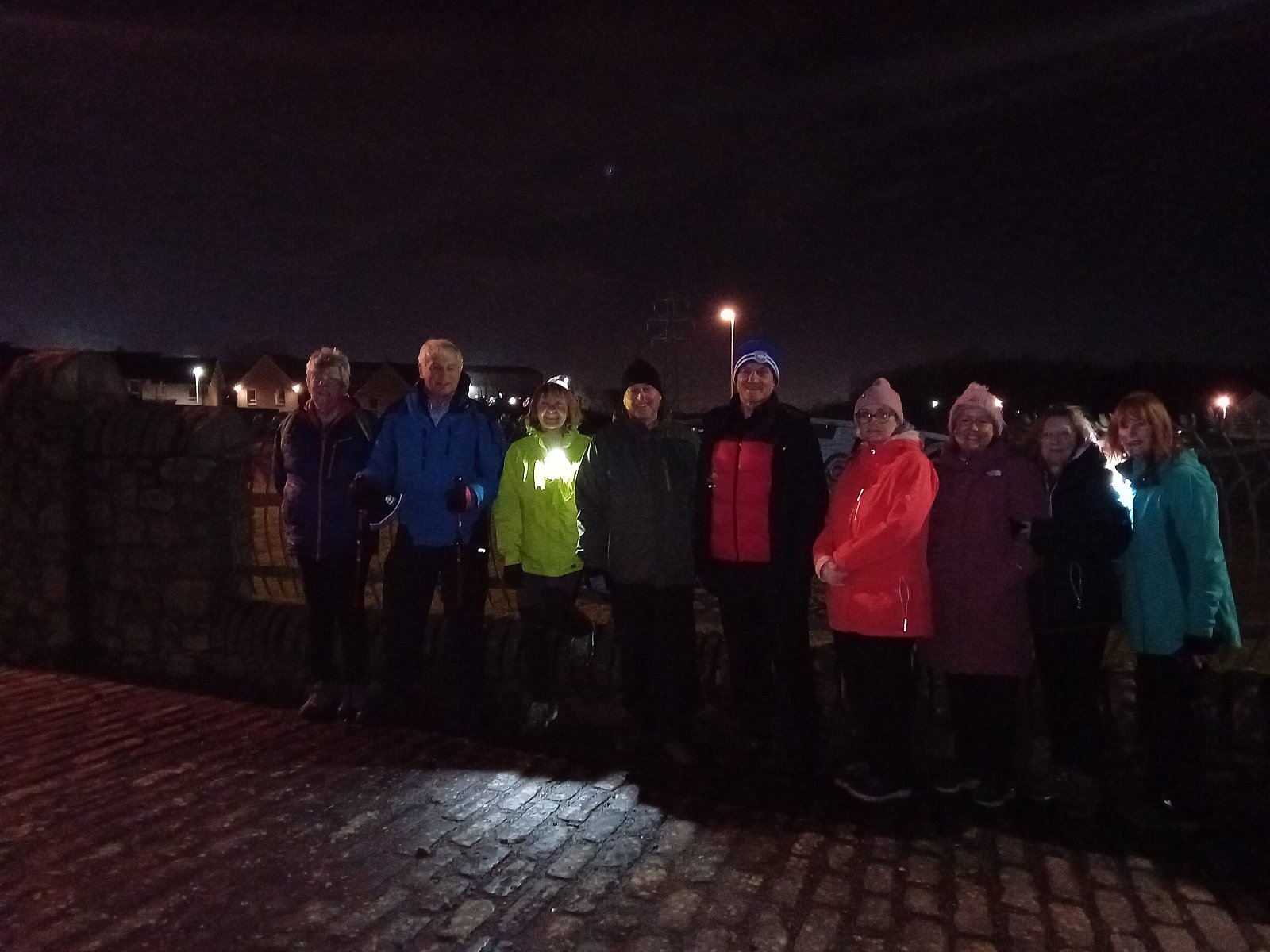
After all the heavy showers today, it was nice to get out & enjoy a walk with nine other Ramblers, this time exploring the village of Wester Inch, Bathgate. Wrapped up warm & with our headtorches switched on we headed off.
We learnt that Wester Inch was built to meet local demand for housing in the area & is now 22 years old! This area was once the site of former industrial plants including the British Leyland Factory & BMC (British Motor Corporation) lorry plant, which closed in 1986. It was fondly remembered by one of our Ramblers on the walk & was great to have his insight into what it was once like working here.
Pausing at the ponds we discovered that these are part of a Sustainable Urban Drainage System, storing water after heavy rain & draining it away slowly into the burn to prevent flooding. These are now home to a wide variety of birdlife all year round.
Walking on through the Bathgate Meadows Nature Park we discovered that this area is part of an ongoing project to transform the once industrial land into an accessible & rich wildlife park for the community to enjoy. The rivers will be regenerated & native planting will attract wildlife whilst new pathways will link different parts of the area. It will be exciting to return here & see what changes have been made.
The path underfoot was lovely smooth tarmac as we were following the National Cycle Network Route 75 which goes from Edinburgh to Glasgow & on to Gourock following railway & riverside paths to reach the ferry at Gourock where you can continue your journey to Tarbert & Loch Fyne. Our route this evening didn’t go that far & we turned off the cycle route to continue around Wester Inch & back towards the start.
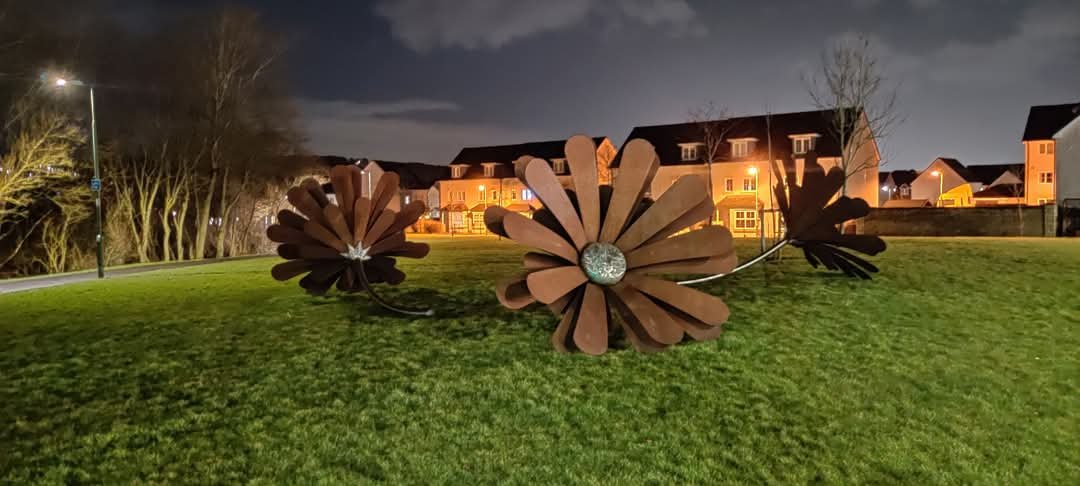
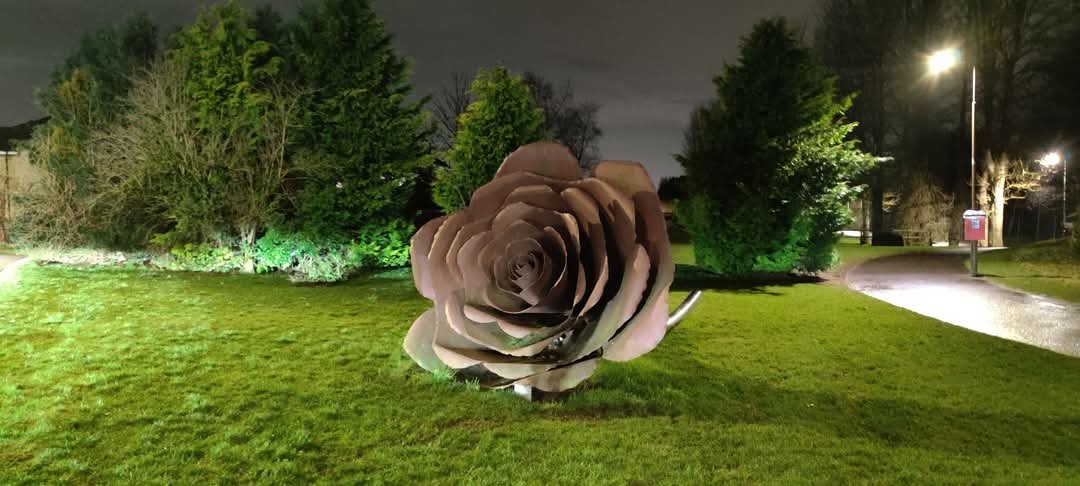
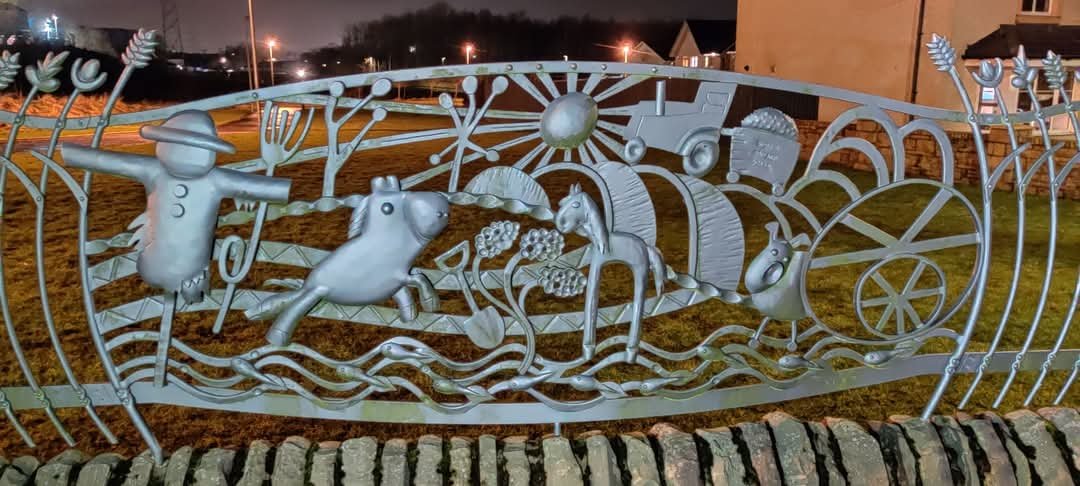
On the way back to our cars we stopped to admire some of the ‘In Bloom’ sculptures which had been commissioned by west Lothian Council & Wester Inch Community Association & were created by artist, Martin Heron in 2012. After consulting with the local community, the theme of flowers kept coming up which inspired the artist & became a metaphor for the blossoming community.
These striking sculptures are made with stainless steel stems which contrast greatly with the Cor-ten steel which was used for the petals & which forms a protective rust layer called ‘Patina’ preventing further corrosion. The heavy industrial material was used as a reference to the manufacturing past of the area, thereby linking the past to the present & future. We passed the ‘Rose’ & the ‘Daisies’ on our walk but know there are also ‘Hibiscus’ & ‘Lily’ sculptures nearby.
Passing a large grassy mound, we stopped to learn that this was in fact another sculpture called ‘The Bathgate Face’. Created by Lumir Soukup in 1998 following winning the commission in 1997. He was inspired by standing at the site surrounded by 20,000 parked vehicles & hearing the roar of the motorway, a completely man-made environment but minus the people who made it following the closure of the factory. He decided to create the human face from rubble of the demolished British Leyland site & when completed was planted with grass & wildflowers. The face was designed from combining the facial measurements of 1216 local faces, making it the largest collective portrait in the world!
Our route finished outside the Simpson Primary School which was built in 2007 to accommodate all the young children who now called this village home. Named after Bathgate born Sir James Young Simpson, the Scottish doctor who discovered the anaesthetic properties of chloroform & successfully introduced it for general medical use. Yet another link to the area’s rich history. Photo credit Ina G & Natalie C
Our next evening walk will be on Thursday 6th March. Keep an eye on the walk programme on our website for detail of this appearing soon.
Natalie C