What an end to our first year of evening walks! A clear night sky to allow us to stop & study the constellations, some planets & some of us even spotted a shooting star which streaked across the sky in front of us. (Only the second time I’ve seen one).
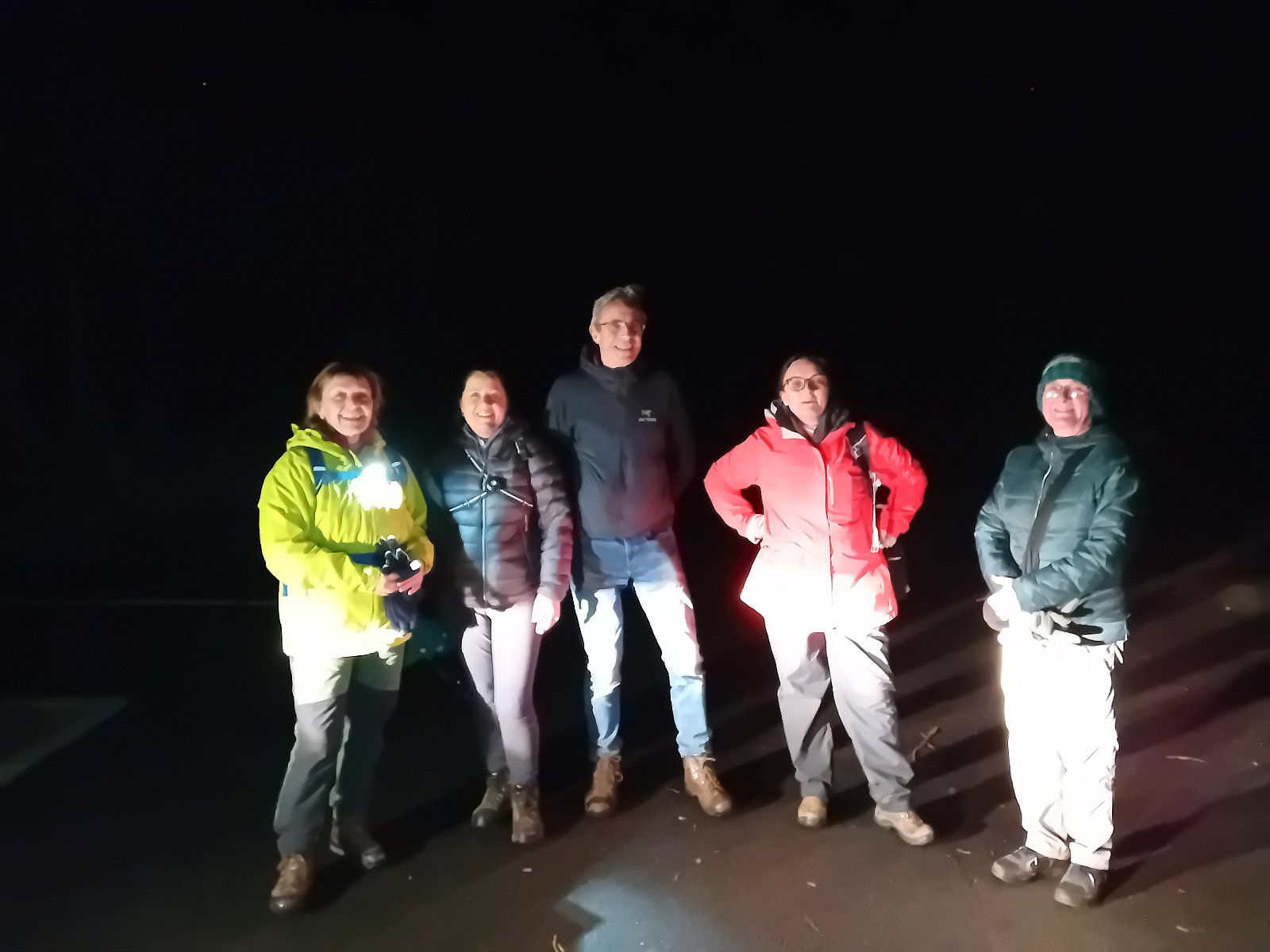
Six Ramblers set off from Threpmuir car park & walked down the side of Threpmuir Reservoir. We stopped to look across the water to see Black Hill silhouetted against the night sky & discover some interesting details about the area. It was a peaceful spot with only the sound of the water lapping the shore & geese honking. Maybe they had spotted our lights & been alerted to our presence!
Both Threpmuir & Harlaw reservoirs were built in the 1840s for the Edinburgh Water Company to help power the mills along the Water of Leith. They were designed by Scottish Civil Engineer James Jardine (the company’s first Civil Engineer). He was not just an accomplished Civil Engineer but also Geologist & Mathematician. He was a lecturer of Maths at Edinburgh University 1796 – 1808 & was the first person in the world to calculate mean sea level.
Threpmuir is the largest of the two reservoirs with a surface area of 71 ha however it is also the shallower of the two with the deepest point being 5.2m & the average depth being 2.4m. The spillway from this reservoir flows directly into Harlaw reservoir. Harlaw reservoir’s surface area covers 11ha however it has an average depth of 7m & at its deepest is 16.5m so make sure you don’t ever fall in!
In 2006, as the reservoirs were no longer used for drinking water, they were sold to the City of Edinburgh Council & are an important part of the City of Edinburgh’s flood prevention scheme slowing the flow of water from streams and burns into the Water of Leith.
During WW2 large wooden poles were sunk into the fields surrounding Threpmuir reservoir to stop aircraft or gliders from landing. Poles were also sunk into the bed of the reservoir & large pyramid structures were also made to stop sea planes landing. When the reservoir dried out in 2018 some of these poles were seen lying on the reservoir bed. No structures were erected in or around Harlaw reservoir as it was felt that it was too tight for a landing & the fringe of trees surrounding the reservoir ably protected it.
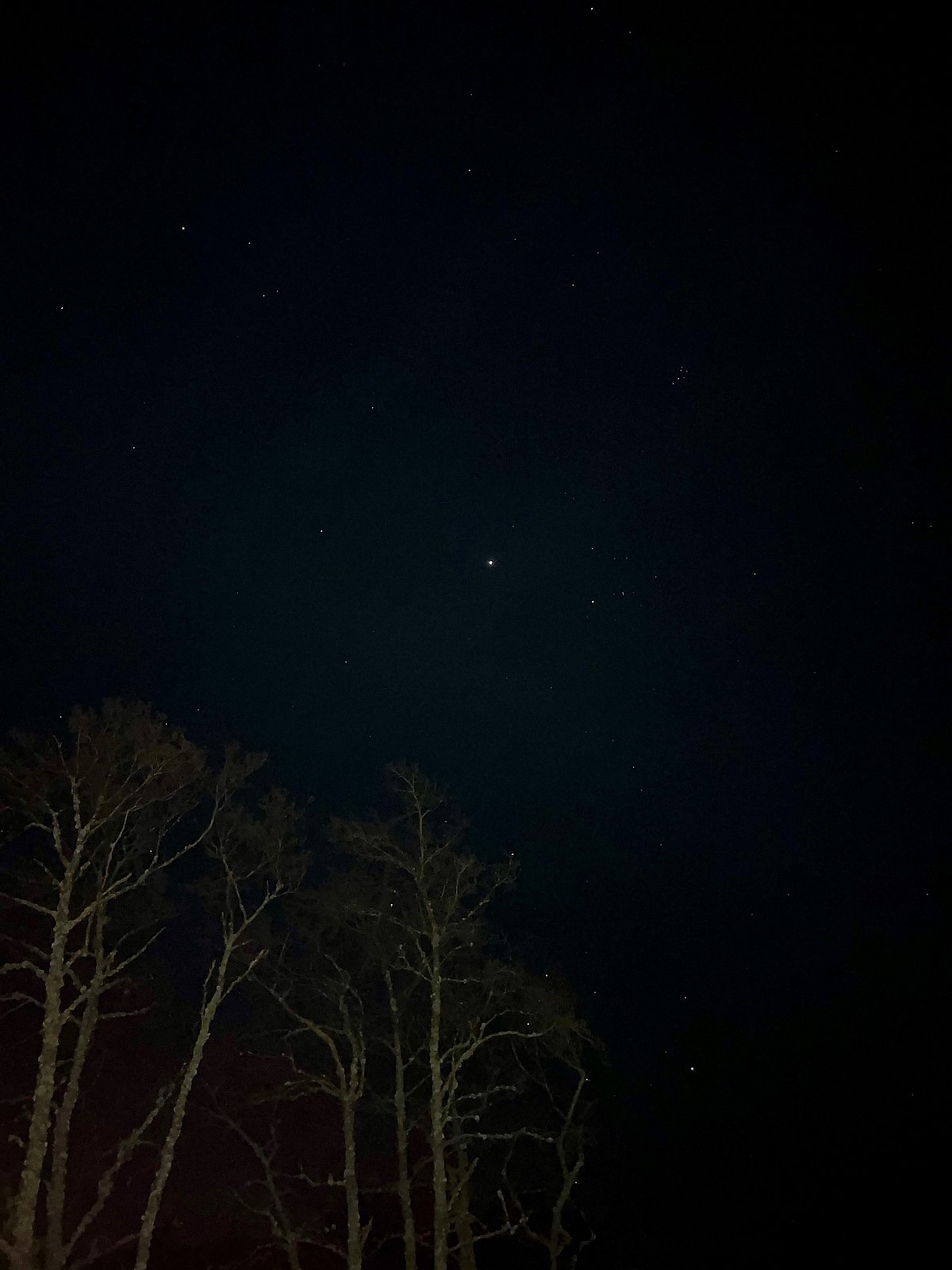
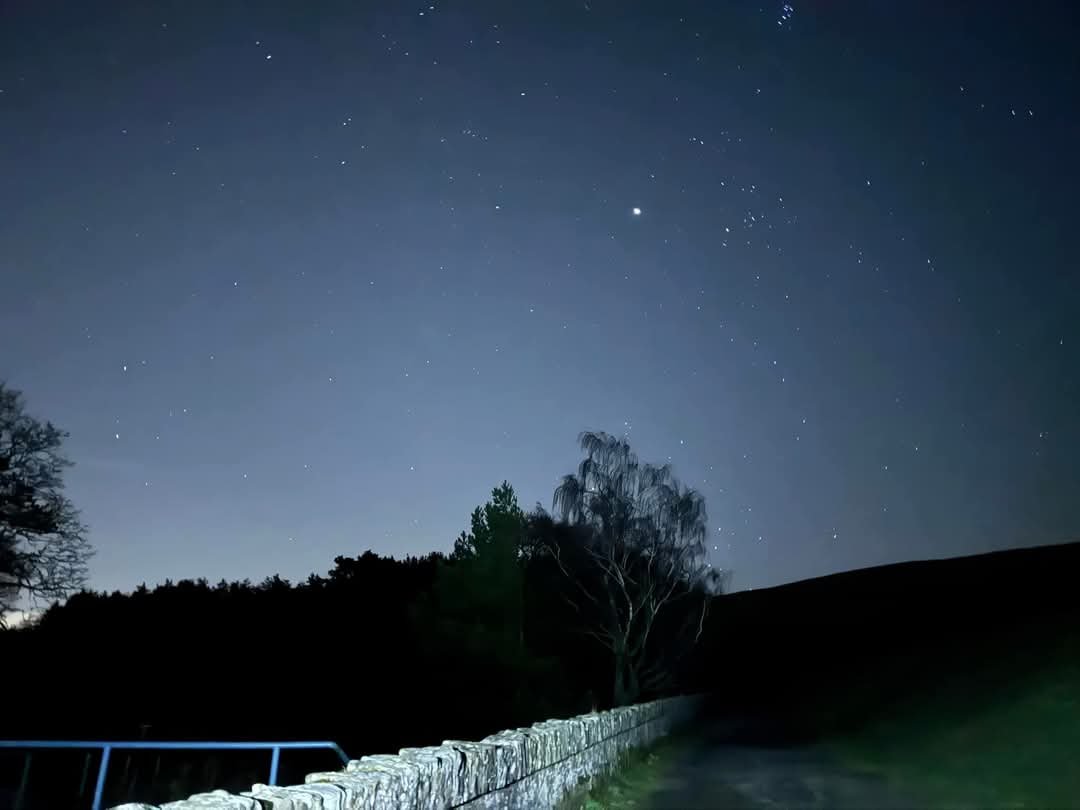
We continued our walk across the bridge over the Threpmuir spillway & along the base of the dry side of the 9.5m high earth dam & through woodland where once back out in the open we stopped & switched off our headtorches to marvel at the night sky.
Our first spot was one of the most recognised star formations, The Plough, otherwise known as the Big Dipper which makes up part of the Ursa Major constellation (Great Bear) & is the third largest constellation in the Northern Hemisphere. From two of the stars of The Plough it is easy to see Polaris (North Star) which shows which way is North, useful thing to know if you are out at night & lose your sense of direction.
Visible from the UK year-round & easily seen in winter is the constellation Cassiopeia which we discovered was named after a vain queen in Greek Mythology. Look for a group of stars which look like a W or M in the sky. This constellation is made up of over 60 stars in total including the brightest star, Cih & an orange giant star, Shedar.
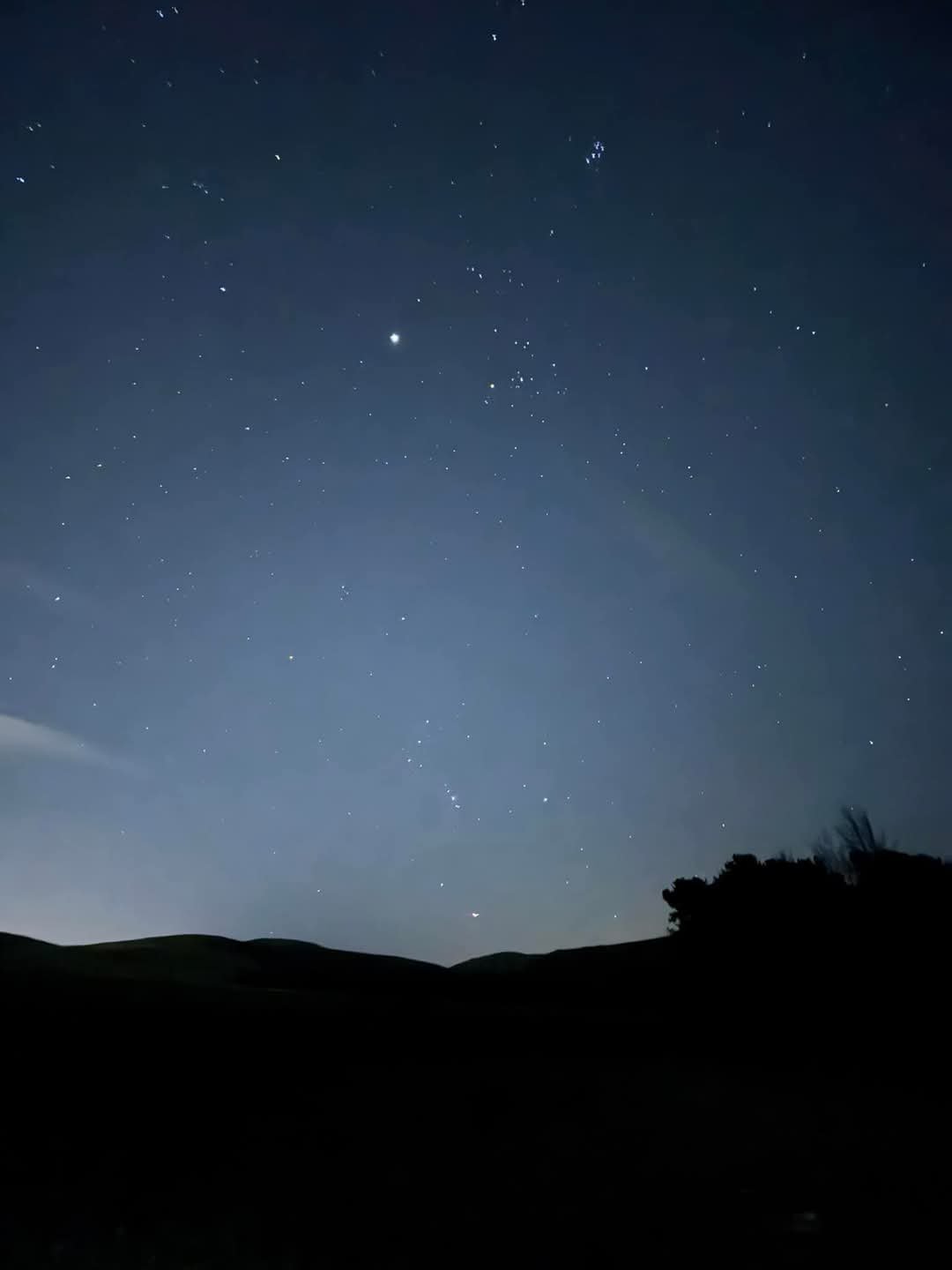
Some of the brighter & larger stars are actually planets & Terry pointed out one of them which was Jupiter before we set off walking again.
Switching our headtorches back on, we continued our walk to reach Black Springs which is a designated wildlife refuge & the second largest reedbed in the Lothians, Duddingston Loch being the largest. Our route then took us up hill through the trees before descending to climb over a stone stile & rejoin the gravel path around Harlaw reservoir.
Beside the Harlaw House Visitor Centre Terry pointed out the Constellation Orion & Orions Belt. As we started to walk along the Harlaw dam a couple of us saw a bright shooting star racing across the sky before burning out. Of course, these are not really stars but small pieces of rock or dust that hits Earth's atmosphere from space. It moves so fast that it heats up and glows as it moves through the atmosphere. A joy to see & such a shame not everyone saw this one last night but it’s a great reason to get out on a clear night & look up at the stars!
On our return to the start point we could see the familiar landmark of the masts near Harthill glowing red in the night sky. Hopefully we will all be able to recognise again the constellations we saw tonight & build on this knowledge. Photo credit: Terry C & Liz S
Thank you to all of you who have joined me on the evening walks this year & made them a successful & fun addition to our group programme. Wishing you all a lovely Christmas & looking forward to many more evening walking adventures with you in 2025.
Our next evening walk is on Thursday 9th January. As always look at our website for details of this & many more walks coming up in January.
Natalie C